
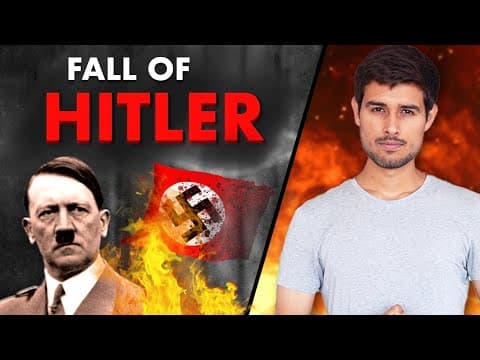
This blog post explores the key events and strategies that led to Hitler's defeat in World War II, highlighting the resilience of Britain, the pivotal battles, and the eventual formation of the Allied Powers that reshaped Europe.
In July 1940, Europe was largely under the control of Adolf Hitler, with only Britain standing against him. This blog post delves into the events that led to Hitler's defeat in World War II, examining the strategies, battles, and alliances that shaped the outcome of the war.
By mid-1940, Germany had invaded and occupied numerous countries, including Austria, Poland, Norway, Belgium, Denmark, and France. The only major European powers left opposing Germany were Britain and the Soviet Union, which had a non-aggression pact with Germany. Meanwhile, the United States remained neutral, unwilling to engage in the conflict.
Hitler believed that Winston Churchill would seek a peace treaty due to the strength of the German army. However, Churchill delivered a powerful speech declaring, "We shall never SURRENDER!" This speech galvanized British resolve and made it clear that the fight against Germany would continue.
In response to Britain's defiance, Hitler planned Operation Sea Lion, aimed at invading the UK. The German Luftwaffe, with 2,600 aircraft, launched an aerial assault on Britain starting on July 10, 1940. The British Royal Air Force, despite being outnumbered, fought valiantly to defend their homeland.
The Luftwaffe's initial goal was to destroy British airfields and aircraft. However, after a series of intense battles, including a significant attack on London, the British managed to repel the German forces. On September 15, 1940, known as Battle of Britain Day, the British downed over 60 German aircraft while losing only 29 of their own. This marked a crucial turning point, as it was the first major defeat for Hitler in the war.
After the failure of Operation Sea Lion, Hitler turned his attention to the Soviet Union, driven by his ideology and desire for expansion. On June 22, 1941, he launched Operation Barbarossa, dividing his forces to attack Leningrad, Moscow, and Ukraine. Despite having superior technology, the German army faced fierce resistance from the Soviets, who eventually joined forces with the Allies.
The Battle of Stalingrad (1942-1943) became one of the deadliest confrontations in history. The Soviet army, despite being outnumbered, managed to encircle and defeat the German troops, marking a significant turning point in the war. The surrender of nearly 300,000 German soldiers in February 1943 weakened Hitler's position considerably.
As the war progressed, the Allied forces, including the UK, the Soviet Union, and the newly involved United States, began to coordinate their efforts. The attack on Pearl Harbor in December 1941 prompted the U.S. to officially enter the war, further bolstering the Allied cause.
On June 6, 1944, known as D-Day, Allied forces launched a massive invasion of Normandy, France. This operation marked the beginning of the liberation of Western Europe from Nazi control. As the Allies advanced from the West, the Soviets pushed from the East, leading to the collapse of German defenses.
In early 1945, as Allied forces closed in on Berlin, Hitler's situation became increasingly desperate. On April 30, 1945, he committed suicide, and on May 8, 1945, Germany formally surrendered. The aftermath of the war saw the division of Germany and the redrawing of European borders.
The end of World War II led to the establishment of the United Nations and the European Coal and Steel Community, which eventually evolved into the European Union. These organizations aimed to foster cooperation and prevent future conflicts in Europe.
The defeat of Hitler in World War II was not just a military victory but a pivotal moment that reshaped the global landscape. The resilience of the Allied forces, the strategic mistakes made by Hitler, and the unity among nations played crucial roles in ending one of history's darkest chapters. The lessons learned from this conflict continue to influence international relations today.



















