
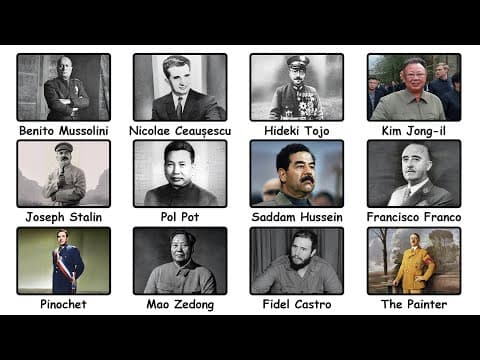
This blog post explores the final moments and deaths of several infamous dictators throughout history, detailing their downfalls, the circumstances surrounding their deaths, and the aftermath of their regimes. From Mussolini to Hitler, each dictator's end reflects the tumultuous times they lived in and the consequences of their actions.
Throughout history, dictators have wielded immense power, often leading to devastating consequences for their nations and the world. However, the ends of these tyrants are often as dramatic as their reigns. This blog post delves into the final moments and deaths of several infamous dictators, highlighting the circumstances surrounding their demise and the aftermath of their regimes.
In 1943, Benito Mussolini was ousted from power by his own government and arrested. Germany intervened, rescuing him and installing him as the puppet leader of the Republic of Salo in northern Italy. By 1945, as Allied forces advanced, Mussolini attempted to flee to Switzerland with his mistress, Clara Petacci. However, they were captured by communist partisans near Lake Como. On April 29, 1945, both were executed, and their bodies were displayed in Milan, where they were subjected to public humiliation.
Nicolae Ceausescu, the repressive leader of Romania, faced a brutal end during the Romanian Revolution of 1989. After a failed rally on December 21, where he misjudged the crowd's anger, he and his wife fled but were captured by the military. On Christmas Day, they were tried by a military court and executed by firing squad, marking a swift end to their oppressive regime.
As Japan's Prime Minister during World War II, Hideki Tojo was arrested after Japan's surrender in 1945. Attempting suicide during his arrest, he survived and was later tried for war crimes. On December 23, 1948, he was executed by hanging, expressing remorse for Japan's actions in his final statement.
Rumors about Kim Jong-Il's health circulated in the late 2000s, with speculation about his death even before it occurred. On December 17, 2011, North Korean state media announced his death from a heart attack while traveling by train. His passing was marked by exaggerated claims of natural phenomena, and he was posthumously declared North Korea's eternal leader.
Stalin's health deteriorated in his later years, leading to paranoia and mistrust of his doctors. On March 1, 1953, he was found semiconscious and died four days later from a cerebral hemorrhage. His death sparked conspiracy theories about foul play, and his funeral drew massive crowds, resulting in a tragic crowd crush.
By the late 1990s, Pol Pot's regime was crumbling. After a power struggle within the Khmer Rouge, he was placed under house arrest by a rival commander. He gave his final interview in 1997, denying responsibility for the genocide. Pol Pot died in his sleep on April 15, 1998, with speculation surrounding the true cause of his death.
Following the U.S.-led invasion of Iraq in 2003, Saddam Hussein's regime collapsed. After months in hiding, he was captured in December 2003. Tried for crimes against humanity, he was sentenced to death and executed by hanging on December 30, 2006, with footage of his execution leaked online.
Franco, Spain's long-time dictator, died on November 20, 1975, after a prolonged illness. His death marked a significant transition for Spain, leading to the eventual establishment of a democratic government. In 2019, his remains were exhumed from a controversial burial site, reflecting ongoing debates about his legacy.
Tito's health declined in the late 1970s, leading to his hospitalization and eventual death on May 4, 1980. His funeral was a monumental event, attended by leaders from around the world, symbolizing his significant role in Yugoslavia and the Cold War.
Pinochet suffered a heart attack on December 3, 2006, and died a week later from complications. His death was met with mixed reactions in Chile, reflecting the deep divisions his regime had created. His funeral was marked by protests and celebrations, illustrating the polarized views on his legacy.
Mao's health deteriorated significantly in his later years, leading to multiple heart attacks. He died on September 9, 1976, and despite his wishes for cremation, his body was embalmed and displayed in a mausoleum, allowing the Chinese people to pay their respects long after his death.
Fidel Castro's health issues began in 2006, leading to a gradual withdrawal from power. He officially stepped down in 2008, and on November 25, 2016, he died at the age of 90. The cause of death was not disclosed, but his passing marked the end of an era in Cuba, where he had survived numerous assassination attempts.
As World War II drew to a close, Adolf Hitler's situation became increasingly desperate. On April 30, 1945, with Soviet troops closing in, he committed suicide in his bunker, alongside Eva Braun. Their bodies were burned as per his instructions, and his death was officially recognized only years later.
The deaths of these dictators reflect the tumultuous times they lived in and the consequences of their actions. Each demise serves as a reminder of the fragility of power and the inevitable downfall that often follows tyranny. The legacies of these leaders continue to shape the political landscapes of their respective countries, leaving behind complex histories that are still being unraveled today.



















