
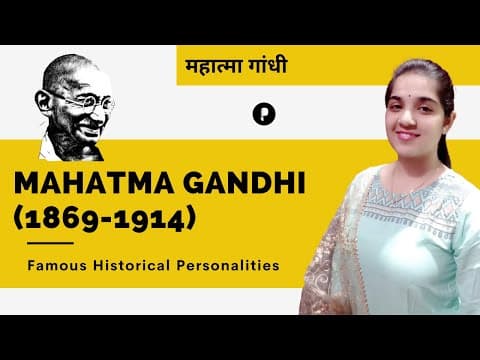
This blog post explores the early life of Mahatma Gandhi, detailing his upbringing, education, marriage, and significant experiences in South Africa that shaped his philosophy and activism. It covers his initial education in India, his journey to London for law studies, and the racial discrimination he faced in South Africa, which led to his transformation into a leader advocating for civil rights.
Mahatma Gandhi, known as the Father of the Nation in India, was originally born as Mohandas Karamchand Gandhi on October 2, 1869, in Porbandar, Gujarat. This blog post delves into the early life of Gandhi, his education, marriage, and the pivotal experiences he encountered in South Africa that laid the foundation for his future activism.
Gandhi was born into a well-to-do family; his father was a diwan (chief minister) in Porbandar. His early education took place in Gujarat, and later, his family moved to Rajkot, where he continued his schooling. At the tender age of 13, he married Kasturba Gandhi, with whom he had four children: Harilal, Manilal, Ramdas, and Devdas.
In 1887, Gandhi traveled to London to study law at the Inner Temple. This decision was influenced by his family's financial stability, as sending a child to study in London during the late 19th century was a privilege reserved for affluent families. Despite initial reluctance, he promised his mother and wife that he would adhere to a strict vegetarian diet and avoid alcohol and women during his stay.
In 1893, after completing his studies, Gandhi returned to India but struggled to establish a successful law practice. An opportunity arose when he was invited to South Africa by a Gujarati merchant, Dada Abdullah, to handle a legal case. This journey marked a significant turning point in Gandhi's life.
Upon arriving in South Africa, Gandhi encountered racial discrimination for the first time. While traveling from Durban to Pretoria, he was forcibly removed from a first-class train compartment simply because of his Indian ethnicity. This incident profoundly impacted him, awakening his awareness of the injustices faced by Indians in South Africa.
Gandhi's initial experience in South Africa was marked by a stark realization of the racial discrimination that pervaded society. He observed that Indians, Chinese, and other Asian communities faced severe restrictions and were treated as second-class citizens. This prompted him to take action.
In 1894, Gandhi founded the Natal Indian Congress to fight for the rights of Indians in South Africa. He began to organize protests against discriminatory laws, advocating for civil rights through nonviolent means, which he termed "Satyagraha."
Gandhi's activism in South Africa can be divided into two phases: the moderate phase (1893-1906) and the resistance phase (1906-1914). During the moderate phase, he focused on raising awareness about the injustices faced by Indians and sought to appeal to the British government for reforms. However, as he witnessed the persistent discrimination, he shifted to a more confrontational approach, leading mass protests and civil disobedience campaigns.
In 1906, the British government passed the Asiatic Registration Act, which required Indians to register and carry identification. Gandhi and his followers refused to comply, leading to mass arrests and further protests. This period solidified Gandhi's commitment to nonviolent resistance and civil disobedience as effective tools for social change.
Gandhi spent nearly 20 years in South Africa, where he developed his philosophy of nonviolent resistance and civil rights advocacy. His experiences there not only shaped his future activism in India but also laid the groundwork for the Indian independence movement. In 1915, he returned to India, ready to lead the struggle for freedom, marking the beginning of a new era in Indian history.
This blog post serves as the first part of a comprehensive exploration of Mahatma Gandhi's life, focusing on his early years and the transformative experiences in South Africa that defined his path as a leader. The next part will delve into his contributions to the Indian National Movement and his enduring legacy.



















