
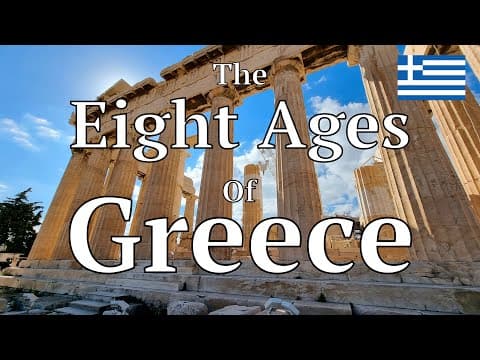
This blog post explores the rich and complex history of Greece, detailing its evolution through eight distinct ages, from the early human settlements to the modern Greek state, highlighting key cultural, political, and military developments that shaped not only Greece but also the wider world.
Civilisation is the collection of humans under a blanket of laws, cities, writing, philosophy, infrastructure, and technology. It separates us from barbarism and a cruel existence. While the origins of civilization are not the focus here, the refinement of civilization in Greece is paramount. At first glance, Greece, a rocky peninsula and archipelago at the southeast edge of Europe, may seem insignificant on a global scale. However, it can be argued that this uninviting land produced a culture that has influenced the world profoundly.
A world without the development of the republic or democracy, athletics, science, critical thinking, or the study of history would be unrecognizable today. Western philosophy is rooted in Greek thought, and modern European languages contain many words derived from ancient Greek. The Greek alphabet is still widely used in science and is the ancestor of key alphabets in use today. Greece's long recorded history showcases a cycle of global influence, conquest, and eventual subjugation, yet its people and language have survived, distinct and proud of their heritage.
As this channel reaches 100,000 subscribers, I want to share my favorite story of a nation: Greece. This country marks the southeastern boundary of Europe and is home to the Greek people, descendants of a culture that spans nearly 5,000 years. The term "Greece" comes from the Latin "Graecia," named after the ancient Graeci tribe that settled in southern Italy. Greeks refer to their country as "Ellada" (Ελλάδα), while in classical times, it was known as "Hellas" (Ἑλλάς). This post will focus on Greece's long history from political, military, and cultural perspectives, while a second part will explore modern Greece's structures, symbols, geography, economy, and culture.
To understand the Greek people today and their ancestors' influence on the world, we must journey through time, breaking it down into eight distinct ages. Each period marks a turning point in events and the fate of its people.
Humans have existed in Greece for as long as 200,000 years, with the oldest skulls of Homo sapiens found here. Farming began around 7000 BC, making it the first in Europe. The Bronze Age saw the rise of the Minoans on Crete around 2700 BC, developing a sophisticated urban culture. The Mycenaean civilization followed on the mainland around 1600 BC, with their writing system, Linear B, marking the emergence of the Greek language.
Around 1500 BC, the volcanic eruption of Thera (modern Santorini) buried the city of Akrotiri, preserving it like a Greek Pompeii. The collapse of the Mycenaean civilization between 1250 and 1180 BC led to a dark age with little known about this period, as writing ceased and cities were abandoned.
Around 800 BC, the Phoenician alphabet was adapted to suit the Greek language, leading to the first alphabet with letters for both consonants and vowels. This period saw the formation of city-states (polis) and the rise of democracy in Athens. The epic poems of Homer, such as the Iliad and Odyssey, emerged, marking the beginning of Greek literature.
The Classical Age was marked by the rise of the Persian Empire, which posed a significant threat to the Greek city-states. Key battles, such as Marathon, Thermopylae, and Salamis, showcased Greek resilience. This era also saw the birth of history as a discipline, with Herodotus documenting events systematically.
Following the conquests of Alexander the Great, Greek culture spread across the Near and Middle East. Alexander's military innovations and his vision of unity among cultures marked this age. His death at a young age led to the division of his empire among his generals, known as the Successor Kingdoms.
The Roman Republic's expansion led to the conquest of Greece, which became a province of Rome. Despite this, Greek culture significantly influenced Roman society, particularly in arts and philosophy. The phrase "Captive Greece captured her rude conqueror" encapsulates this cultural exchange.
The Eastern Roman Empire, known as the Byzantine Empire, continued the legacy of Greek civilization. Greek became the official language, and the empire thrived culturally and economically for centuries. However, it faced challenges from invasions and internal strife, culminating in the Fourth Crusade, which weakened the empire.
The fall of Constantinople in 1453 marked the end of Byzantine rule and the beginning of Ottoman domination. Despite hardships, the Greek spirit endured, leading to a resurgence of independence in the 19th century. The modern Greek state emerged, navigating political turmoil and economic challenges, including the recent financial crisis.
Over five millennia, Greece has experienced cycles of rise and fall, from the Bronze Age to the modern state. Its rich culture has influenced the world profoundly, and the story of Greece is one of resilience and continuity. As we look forward to Part 2, we will explore the geography, economy, and contemporary culture of Greece, celebrating its enduring legacy.



















