
This blog post explores the presidency of Dwight D. Eisenhower from 1952 to 1960, highlighting his domestic policies, foreign relations during the Cold War, the Civil Rights Movement, and the cultural landscape of 1950s America.
Welcome back, history enthusiasts! Today, we delve into the presidency of Dwight D. Eisenhower, who served as the 34th President of the United States from 1952 to 1960. Eisenhower's era was marked by significant events and transformations in American society, politics, and culture. This post will cover his domestic policies, foreign relations during the Cold War, the Civil Rights Movement, and the cultural landscape of the 1950s.
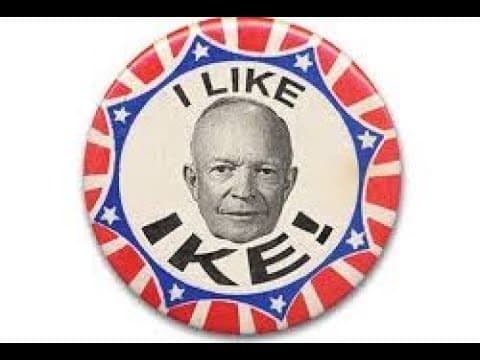
Dwight D. Eisenhower, a former General, was elected president in 1952 with the campaign slogan "I like Ike." He was a moderate Republican, while his vice president, Richard Nixon, was more conservative and known for his strong anti-communist stance. Nixon faced accusations of campaign fund mismanagement but salvaged his political future through a televised speech known as the "Checker speech," where he emotionally defended his integrity.
Eisenhower's approach to governance was characterized by moderate Republicanism. He aimed to balance the federal budget and cut government spending while accepting the New Deal's legacy as a job creator and welfare provider. Notably, he extended Social Security and established the Department of Health, Education, and Welfare.
One of Eisenhower's most significant domestic achievements was the creation of the Interstate Highway System through the Highway Act of 1956. This initiative connected major cities with a network of highways funded by taxes on fuel, tires, and vehicles. The system was justified as a national defense measure, providing evacuation routes in case of a Soviet nuclear attack. Its impact was profound, leading to job creation, the growth of the trucking industry, suburban expansion, and a more homogeneous national culture.
The 1950s were marked by economic prosperity, with low inflation and a tripling of per capita income. The United States enjoyed the highest standard of living in the world, a feat that has not been matched since.
Eisenhower's foreign policy was heavily influenced by the Cold War and the need for containment of communism. His Secretary of State, John Foster Dulles, advocated for a new approach known as brinksmanship, which involved pushing the Soviet Union to the brink of war while relying on nuclear deterrence.
Eisenhower ended the Korean War in 1953, achieving a stalemate that left North and South Korea technically still at war. His administration also dealt with the decolonization of nations in Asia and Africa, where many countries gained independence post-World War II.
The CIA played a crucial role in U.S. foreign policy during this period, engaging in covert actions to overthrow governments perceived as threats. Notable examples include the 1953 coup in Iran and the 1954 intervention in Guatemala. These actions often led to long-term anti-American sentiments in the affected regions.
The Suez Crisis of 1956 highlighted the complexities of U.S. relations in the Middle East. Eisenhower's Doctrine pledged military and economic aid to any Middle Eastern nation threatened by communism, further entrenching U.S. involvement in the region.
The Civil Rights Movement gained momentum during the 1950s, with significant milestones such as the integration of Major League Baseball by Jackie Robinson in 1947 and President Truman's desegregation of the armed forces in 1948. Despite these advancements, racial segregation persisted, particularly in the South.
The landmark Supreme Court case Brown v. Board of Education in 1954 declared that segregation in public schools was unconstitutional, stating that "separate is inherently unequal." This ruling faced resistance, particularly in Southern states, leading to significant confrontations, such as the Little Rock Nine incident in 1957, where federal troops were deployed to escort African American students into a segregated school.
The Montgomery Bus Boycott, sparked by Rosa Parks' refusal to give up her seat, marked a pivotal moment in the movement. Led by Martin Luther King Jr., the boycott successfully ended segregation on public buses. The Southern Christian Leadership Conference (SCLC) was established to coordinate nonviolent protests, while the Student Nonviolent Coordinating Committee (SNCC) emerged to organize sit-ins at segregated lunch counters.
The 1950s were characterized by a culture of conformity, driven by a consumer economy. Television became central to American life, with limited channels broadcasting sitcoms, westerns, and sports. The rise of brand names and shopping centers reflected a shift towards a consumer-driven society.
The decade also saw the emergence of rock and roll, with figures like Elvis Presley becoming cultural icons. Literature from the Beat Generation, including works by Jack Kerouac and Allen Ginsberg, challenged societal norms and celebrated spontaneity and rebellion.
Critics of the era, such as David Riesman and John Kenneth Galbraith, highlighted the dehumanizing aspects of corporate culture and the failure of the affluent to contribute to the common good. The dissatisfaction among educated women began to surface, questioning traditional roles in society.
Eisenhower's presidency was a complex period marked by significant achievements and challenges. His legacy includes the establishment of a prosperous economy, the navigation of Cold War tensions, and the beginnings of the Civil Rights Movement. As we reflect on the Eisenhower years, we see a nation grappling with its identity and values in a rapidly changing world.



















