
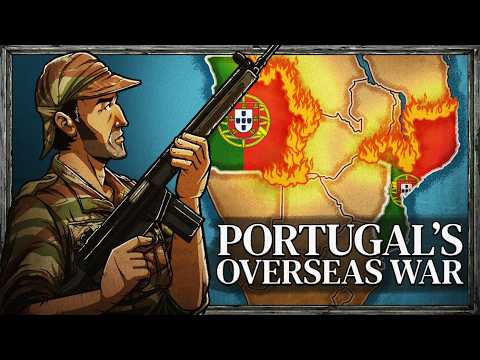
Portugal's colonial empire, once a global maritime power, faced significant challenges and conflicts in Africa during the 20th century, leading to its eventual decline and decolonization following the Carnation Revolution in 1974. The struggles in Angola, Mozambique, and Guinea-Bissau highlight the complexities of colonial rule and the rise of nationalist movements that ultimately dismantled Portugal's grip on its territories.
Colonialism in Africa is often associated with Britain and France, yet it was Portugal that pioneered the establishment of trading outposts and territories during its Golden Age of Exploration. By the 20th century, however, Portugal's once vast empire had significantly diminished, with its largest remaining territories in Africa being Angola, Mozambique, and Guinea-Bissau. The conflicts that ultimately led to the end of the Portuguese Empire can be traced back to the latter half of the 19th century, during Portugal's campaigns of pacification and occupation in Africa.
The authoritarian regime known as the Estado Novo, established under António de Oliveira Salazar in 1933, played a crucial role in Portugal's colonial policies. This regime resisted global democratic movements and decolonization pressures, intertwining its nationalistic and corporatist policies with colonial ambitions. Salazar's government viewed Portugal's colonies as overseas provinces, a belief enshrined in the regime's constitution, which declared these territories as inalienable parts of Portugal.
Unlike other European powers, Portugal was determined to resist decolonization, even as other nations began to yield to liberation struggles. Salazar argued that stability in the colonies was essential for Western interests in Africa, a claim that, while met with skepticism, allowed Portugal to maintain control over its territories.
Portugal's colonial strategy focused on economic exploitation, extracting cash crops and minerals with little regard for local sustainability. In Angola and Mozambique, forced labor was widespread, and infrastructure was developed primarily to facilitate resource exportation rather than to benefit local populations. The regime promoted Luso-tropicalism, claiming that the Portuguese were uniquely suited to manage tropical territories, which justified the imposition of Portuguese culture and language on the colonies.
To enforce these policies, Portugal maintained a strong military presence in its African colonies, employing extensive political repression, surveillance, and censorship to stifle dissent. The secret police, known as the PIDE, actively monitored and detained activists and suspected nationalists. While other colonial powers faced violent uprisings, Portugal remained steadfast in its belief in the righteousness of its mission to civilize and integrate its African territories.
By the 1960s, however, liberation groups began to gain momentum, challenging Portuguese rule. In Angola, the demand for independence was fueled by widespread economic exploitation and systemic injustices. The Angolan nationalist movements, including the People's Movement for the Liberation of Angola (MPLA), the National Front for the Liberation of Angola (FNLA), and the National Union for the Total Independence of Angola (UNITA), emerged, each aiming for independence through armed struggle.
The conflict escalated into a full-scale guerrilla war, with Portuguese forces deploying specialized units to suppress the rebellion. Notable military operations included Operation Várzea and Operation Nea, which utilized heavy artillery and air support. However, the ruthless tactics employed by Portuguese forces often exacerbated the humanitarian crisis, leading to widespread displacement and casualties.
As the conflict in Angola intensified, foreign intervention became a significant factor. The MPLA received support from the Soviet Union and Cuba, while the FNLA and UNITA garnered backing from the United States, South Africa, and Rhodesia. This international involvement escalated the conflict, introducing sophisticated weaponry and foreign mercenaries into the fray.
In Mozambique, the FRELIMO (Mozambique Liberation Front) emerged as a key player in the anti-colonial struggle. Established in 1962, FRELIMO initially focused on political education and international support before transitioning to armed insurrection in 1964. The group received substantial backing from communist countries, which was crucial for sustaining its military campaign against Portuguese forces.
The prolonged conflicts in Africa, coupled with mounting casualties and economic burdens, began to erode public sentiment in Portugal. The realities of war, previously shielded from the Portuguese populace by censorship, led to growing discontent. This shift culminated in the Carnation Revolution on April 25, 1974, a military coup led by young officers disillusioned with the dictatorship and the ongoing colonial wars.
The peaceful revolution dramatically altered Portugal's political landscape, leading to the overthrow of the Estado Novo regime. The new government, more attuned to democratic ideals, swiftly moved to decolonize, recognizing that the wars were unwinnable and detrimental to the country's future. From 1974 to 1975, rapid negotiations resulted in the independence of Portugal's remaining African colonies, including Guinea-Bissau, Mozambique, and Angola.
Despite gaining independence, the newly formed nations faced significant challenges. In Mozambique, the government became embroiled in regional independence conflicts, while Angola experienced immediate internal divisions among its liberation factions, leading to a devastating civil war. Guinea-Bissau's vision of a Marxist one-party state struggled with political instability, and thousands of African soldiers were executed for siding with the Portuguese.
The legacy of colonial rule continued to loom over these nations long after they broke free from Portuguese control, highlighting the complex and often painful transition from colonialism to independence. The end of Portugal's colonial empire serves as a poignant reminder of the struggles for self-determination and the lasting impacts of colonialism in Africa.



















