The Peak to Peak Gondola at Whistler Blackcomb is a groundbreaking engineering feat that connects two mountain peaks without descending into the valley, significantly reducing travel time for skiers. Built over two years, it features innovative cable systems and complex logistics to transport heavy cables, making it a remarkable achievement in ski resort infrastructure.
Whistler Blackcomb, located in British Columbia, is renowned as the largest ski resort in North America. However, its vast size presents unique challenges, particularly in facilitating transportation between its two mountain peaks. For decades, skiers had to navigate a lengthy route that involved descending one mountain, traveling back to Whistler Village, and then ascending the other mountain. This cumbersome journey could take over an hour, leading to a less than ideal experience for visitors.
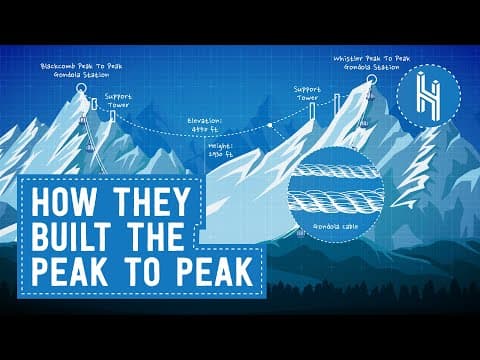
The solution to this transportation dilemma was clear: a gondola. However, a traditional gondola would still require a descent into the valley, which would not significantly reduce travel time. The innovative idea was to create a gondola that could traverse directly between the two peaks without descending into the valley below. This ambitious project would require a gondola to span nearly two miles without a single support tower, all while withstanding hurricane-level winds hundreds of feet above the valley floor.
Creating a gondola that could operate under these conditions posed significant engineering challenges. A single gondola cable is not designed to support gondola cars over such long distances without additional support. To address this, engineers designed the Peak to Peak Gondola with three cables: the standard haul rope and two additional cables that would act as tracks for the gondola cars. This innovative design also included a rescue vehicle capable of riding the same tracks and radar systems to detect incoming aircraft, creating a reliable aerial transport system.
Whistler Blackcomb set a two-year timeline for the construction of the gondola, but in the world of ski resort construction, two years is often less than it seems. The four towers that would support the gondola could only be constructed during the spring and summer months, as snow would prevent cement trucks from accessing the mountain. On days when weather conditions were unfavorable, cement had to be delivered by helicopter.
By the spring of 2008, all four towers were completed, but the most complex part of the project lay ahead: the installation of the cables. The cables, each measuring 15,000 feet long and weighing 97 tons, were designed to hold an astonishing 767,000 pounds without snapping. These cables had to be produced in Switzerland, a process that involved significant logistical challenges.
Transporting the heavy spools of cable from Switzerland to Whistler was no small feat. The spools were shipped via cargo ship across the Atlantic, through the Panama Canal, and to the port of Vancouver. Due to their weight, they could not be loaded onto traditional semi-trucks; instead, they were welded directly onto a train for transport to Whistler.
However, the journey was complicated when the head of the Canadian National Railway parked his luxury rail car on the tracks, blocking access. To resolve this, one of the developers had to leverage their investment in the railway to contact the railway's president directly, persuading him to move his train.
Once the spools arrived at the train yard in Whistler, they needed to be transported up the mountain. A specialized 48-wheel heavy haul trailer was brought in from Montreal, which used hydraulic technology to lift the spools. The journey up the mountain was arduous, requiring two trucks to pull and push the trailer, taking 19 hours to move just one spool. This process was repeated five times to transport all the necessary cables.
With the spools finally at the top of Blackcomb Mountain, the next challenge was to pull the cables across the four towers. Due to their weight, the cables could not be transported by helicopter. Instead, a smaller cable was threaded through the towers and attached to the main cables to pull them across. This process took an astonishing 12 weeks of continuous effort.
The installation of the haul rope, which needed to form a complete loop, presented additional challenges. The connection point had to be as strong as the rest of the cable while remaining uniform in thickness. This required a specialized splicing technique performed by Norm Duke, one of the few experts in North America capable of such a task. Over two days, he meticulously wove the cable back together by hand.
By late August 2008, the Peak to Peak Gondola was completed, transforming what was once an hour-long journey into an 11-minute ride. This engineering marvel not only enhanced the skiing experience at Whistler Blackcomb but also showcased the ingenuity and determination of the teams involved in its construction.
The Peak to Peak Gondola stands as a testament to modern engineering, overcoming significant challenges to connect two mountain peaks in a way that was previously thought impossible. It has redefined the skiing experience, allowing visitors to enjoy both mountains in a single day, all while enjoying breathtaking views from one of the highest gondolas in the world.