
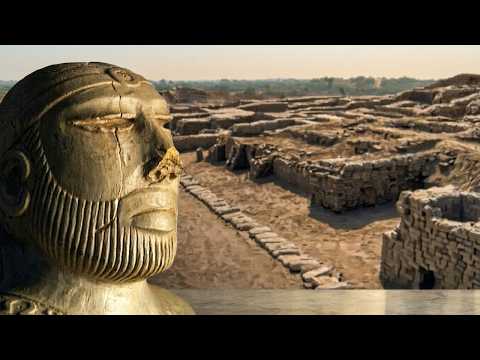
The Indus Civilization, flourishing for 500 years along the River Indus, remains a mystery despite extensive archaeological discoveries. This blog post explores the advanced urban planning, water management, trade practices, and eventual decline of this ancient civilization, highlighting its lasting legacy in modern India.
The ruins of great cities do not tell us everything about the people who built them. In the mud-walled streets of the Indus Valley, a mystery 5000 years old still lingers. The key to understanding this ancient civilization may lie with the River Indus, a mystical silver serpent that rises in the Himalayas and flows through an immense landscape. Despite the floods, people settled on its banks, tamed the rivers, and transformed the desert into lush gardens. However, what do we truly know about them?
The Indus Civilization flourished for approximately 500 years before vanishing into historical obscurity. It left behind a sacred heritage: water. In 1920, Professor M.S. Vats gazed over the remains of Harappa, a key site in the Indus Civilization, while Professor Adi Banerjee excavated the ruins of Mohenjo-Daro. European archaeologists were astonished by the extent of early Asian civilizations, as over a thousand sites have been discovered in a region covering a million square kilometers.
The Indus River, born of the Himalayan snows and bounded by Pakistan and India, is 3,000 kilometers long. Its valley was home to a thriving civilization, yet our understanding of it has been clouded. Early archaeologists unearthed toys, dice, and marbles, leading them to believe the people were carefree and oblivious to death and war, likening them to the Arcadians of the Indus.
Mohenjo-Daro, located on the banks of the Indus in southern Pakistan, was settled around 2000 BC by newcomers from ancient Persia. At its peak, it was the largest city of the Indus Civilization, housing around 40,000 people within a square kilometer. The city layout exemplified ancient town planning, with long, straight streets crossing at right angles and main streets never less than nine meters wide.
Archaeologists were surprised to discover a complex water management system in Mohenjo-Daro, which included 80 public toilets, tiled bathrooms in every house, and a sophisticated sewer system. The most remarkable find was a large public bath, surrounded by a gallery with fountains, serving as a communal space for daily ablutions.
Dholavira, another significant city, showcased monumental stone walls and a complex water system. Archaeologists uncovered deep pits and reservoirs, revealing the advanced engineering skills of the Indus builders. Dholavira had 16 reservoirs, providing 250,000 cubic meters of precious water, essential for irrigation and daily life.
The people of the Indus mastered water management, which was crucial for their survival in a land alternately scorched by the sun and flooded by monsoons. They built dams to control the flow of water and constructed aqueducts to transport it throughout the city. The stored water allowed them to irrigate fields year-round, making Dholavira a thriving center of agriculture.
The ruins of Dholavira now lie silent, but they tell a story of a civilization that revered water. The citadel featured a system for collecting rainwater, and a sacred well served as a place for purification rituals. For the Dholavirans, water was not just a resource; it was a fundamental element of life and spirituality.
Another mystery surrounds the rediscovered cities of the Indus Civilization, many of which are located in inhospitable desert regions. Archaeologists have linked these sites to the Ghagger-Hakra River, once a powerful waterway that flowed through the Tar Desert. Evidence of ancient dikes and water management systems suggests that the people adapted to their environment, utilizing the river's resources for agriculture and trade.
By 2000 BC, the people of the Indus began to explore beyond their borders, seeking mineral resources like copper and tin. They established trade routes and colonies over 1,500 kilometers away, reaching as far as Mesopotamia. The development of long-distance trade led to the invention of contracts and the use of seals for marking goods, indicating a sophisticated economic system.
Archaeologists have discovered over 2000 seals, often adorned with intricate animal motifs and inscriptions. However, the Indus script remains undeciphered, leaving many questions about the civilization's governance and cultural practices unanswered.
From around 1800 BC, the Indus Civilization began to decline. The reasons for this sudden decay are still debated among experts. Some suggest invasions from Central Asia, while others point to natural disasters like floods or earthquakes. The disappearance of the Ghagger-Hakra River may have forced irreversible changes to their way of life.
As the empire fragmented, the fertile lands around Harappa, Mohenjo-Daro, and Dholavira became independent states. New crops emerged, and the once-unified civilization adopted diverse cultures. Yet, remnants of the Indus heritage persisted, influencing future generations.
Today, the legacy of the Indus Civilization can be seen in the rituals and practices of modern India. The worship of water, a fundamental element for the Indus people, continues to resonate in the cultural practices surrounding the Ganges River. The civilization's mastery of water management and agricultural techniques laid the groundwork for future societies.
In conclusion, the Indus Civilization remains a brilliant chapter in human history, characterized by advanced urban planning, sophisticated trade networks, and a deep reverence for water. As archaeologists continue to uncover its secrets, we are reminded of the enduring legacy of a people who thrived along the banks of the River Indus.



















