
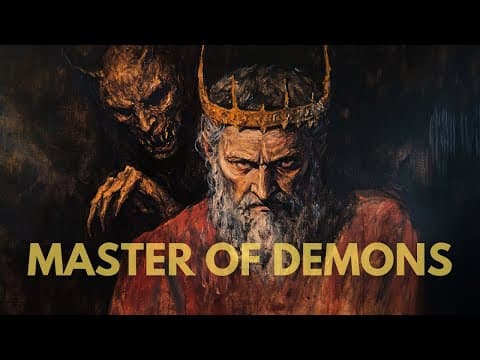
King Solomon, a figure of immense wisdom and power, is shrouded in mystery and legend. His reign marked a golden age for Israel, yet his life was filled with contradictions, including his relationships with foreign gods and the eventual decline of his kingdom. Solomon's legendary Temple remains lost, and tales of his supernatural abilities, including the Seal of Solomon, blur the lines between history and myth.
King Solomon, a name that echoes through history, religion, and legend, is often depicted as a king blessed with unparalleled wisdom and power. His story is one of contradictions, ambition, and ultimate downfall, leaving behind more questions than answers. Did Solomon truly exist, or has his legend outgrown reality? What happened to the Temple he built, said to be constructed by both men and spirits? This blog post delves into the life and legacy of Solomon, exploring his wisdom, wealth, and the supernatural elements that surround his story.
Solomon was the third king of Israel, the son of David and Bathsheba. His reign, described in the books of Kings and Chronicles, is often portrayed as a golden age characterized by immense wealth, wisdom, and prosperity. He ruled for 40 years, expanding Israel's influence, securing diplomatic alliances, and overseeing the construction of the legendary Temple of Solomon in Jerusalem.
Solomon's most defining trait was his wisdom, granted to him in a dream where God offered him anything he desired. Instead of riches or military power, Solomon requested wisdom, which led to his unmatched ability to govern with fairness and insight. His skill in resolving disputes became legendary, exemplified by the famous Judgment of the Two Mothers, where he cleverly determined the true mother of an infant by proposing to cut the baby in half.
His reputation for wisdom spread beyond Israel, and he was believed to have held counsel with foreign rulers, philosophers, and sages. Solomon is credited with writing Proverbs and the Song of Songs, although scholars debate his authorship.
According to First Kings 10, Solomon's kingdom flourished through trade, strategic marriages, and tributes from surrounding nations. His reign saw the establishment of new trade routes, bringing in gold, silver, precious stones, and exotic spices. The Queen of Sheba famously visited his court, testing him with riddles and leaving in awe, gifting him lavish treasures.
Solomon's throne was said to be crafted from ivory and pure gold, flanked by twelve lion statues, symbolizing his unparalleled power. His military strength grew as he amassed chariots, war horses, and an army equipped with the latest weaponry of the era.
Despite his wealth and influence, Solomon's reign was marked by increasing divides between the elite and the common people. His grand building projects, including the Temple and his own palace, relied on heavy taxation and forced labor, breeding resentment among his subjects.
The Bible states that Solomon took many foreign wives—700 wives and 300 concubines—and allowed the worship of their gods, angering Yahweh. His focus on grandeur and wealth led to heavy taxation and forced labor, which ultimately fractured his kingdom upon his death, splitting it into the Northern Kingdom of Israel and the Southern Kingdom of Judah.
Despite his legendary status, Solomon remains a mystery in the historical record. Unlike Egyptian pharaohs or Mesopotamian kings, there are no contemporary inscriptions, monuments, or direct archaeological evidence proving his existence. The only sources describing him are religious texts, leading scholars to debate whether he was a real king whose legacy was exaggerated or a symbolic figure representing an idealized ruler.
Some theories suggest that Solomon may have been a composite of multiple rulers, a literary creation blending history and myth. Others argue that while evidence is scarce, the lack of inscriptions does not necessarily mean he did not exist, as many rulers of the ancient Near East left behind little physical proof of their reigns.
Solomon's greatest architectural achievement was the construction of the first Temple, described in First Kings and 2 Chronicles. Built on Mount Moriah, the Temple was meant to be the dwelling place of Yahweh on earth, a place of worship, sacrifice, and divine presence. However, today, no trace of it remains.
The Temple was constructed using cedar from Lebanon, quarried stone, and gold-covered interiors, with intricate carvings decorating its halls. It was divided into three main sections: the outer court, the holy place accessible only to priests, and the holy of holies, where the Ark of the Covenant was housed.
The fate of the Ark remains one of history's greatest mysteries. Some believe it was hidden beneath the Temple, smuggled out of Jerusalem, or taken to Ethiopia, where it is said to be housed in the Church of Our Lady Mary of Zion. The Temple stood as the spiritual heart of Israel until it was destroyed by the Babylonian King Nebuchadnezzar II in 586 BCE, with the treasures looted and the Ark never seen again.
One of the most intriguing figures connected to Solomon's story is the Queen of Sheba, who traveled to Jerusalem with a caravan laden with gold, spices, and precious stones to test Solomon's wisdom. Her exact location remains uncertain, but many believe she ruled in modern-day Ethiopia or Yemen.
The biblical account states that she was impressed by Solomon's wisdom and grandeur, gifting him vast riches. In Islamic tradition, she is known as Bilqis, and her story includes her conversion to the worship of Allah after witnessing Solomon's power. Ethiopian legends claim that she and Solomon had a son named Menelik, who later brought the Ark of the Covenant to Ethiopia, establishing a royal dynasty.
Some stories claim that Solomon's true power came from a ring known as the Seal of Solomon, which granted him dominion over spirits. This legendary artifact is said to have allowed him to bind spirits, exercise demons, and command jinn. The Testament of Solomon, an ancient text written centuries after his time, presents him not just as a wise ruler but as a sorcerer king.
According to this text, Solomon received his ring from the Archangel Michael, enabling him to interrogate spirits and extract their knowledge. The Testament describes a hierarchy of spirits, each with their own abilities, and claims that Solomon forced them into servitude to help construct the Temple.
In Islamic tradition, Solomon is known as Sulayman, a prophet of Allah and a righteous king. The Quran describes him as a just ruler blessed with wisdom, wealth, and control over the winds and jinn. Unlike the biblical account, which portrays Solomon's later years as a period of decline, the Islamic version presents him as a faithful servant of God until his death.
The story of the Queen of Sheba in Islamic texts emphasizes her conversion to monotheism after meeting Solomon, highlighting his prophetic authority.
The legacy of King Solomon is a complex tapestry woven from history, myth, and the supernatural. His reign was marked by wisdom, power, and prosperity, yet his life serves as a cautionary tale of excess and decline. The Temple he built remains lost, and the Seal of Solomon, if it ever existed, is shrouded in mystery. Solomon's name has transcended time, celebrated by prophets, mystics, and sorcerers alike. Whether he was a wise king, a master of spirits, or something more, one thing remains clear: his legend continues to captivate and intrigue, leaving us to ponder the truth behind the man and the myth.



















