Robert Johnson, a legendary blues musician, rose from obscurity to fame through his mysterious life, rumored pact with the devil, and profound musical influence, despite his untimely death at 27.
Robert Johnson's name is synonymous with the blues, marking him as one of the most iconic figures in the genre. Despite his legendary status, very little is known about his life, with only 29 songs and two verified photographs to his name. His story is shrouded in mystery, and his artistry continues to resonate with millions. This blog post delves into the life, struggles, and legacy of Robert Johnson, exploring the myths surrounding his rise to fame and his untimely demise.
Robert Johnson was born on May 8, 1911, in Hazlehurst, Mississippi, to Julia Dodds and Noah Johnson. His birth was illegitimate, and he likely never met his biological father. His stepfather, Charles Dodds, was a successful landowner, but after a dispute with a lynch mob, the family moved to Memphis. Robert lived with his stepfather until he was about eight or nine, after which he returned to Mississippi to live with his mother and her new husband, Dusty Willis.
As a teenager, Johnson developed an interest in music, learning the basics of guitar from one of his brothers and gaining recognition as a talented harmonica player. However, his musical aspirations clashed with his stepfather's expectations, who wanted him to work on the plantation fields. This conflict led Johnson to seek independence, and at 19, he married Virginia Travis, a 16-year-old. Tragically, she died a year later during childbirth, leaving Johnson a young widower with a tumultuous family life.
In the early 1930s, Johnson's life took a pivotal turn when he encountered the legendary blues artist Sun House, who performed nearby. Although Johnson was initially considered a poor musician, he was determined to improve. He would often ask to play the guitars of more established musicians during breaks, but his attempts were met with ridicule.
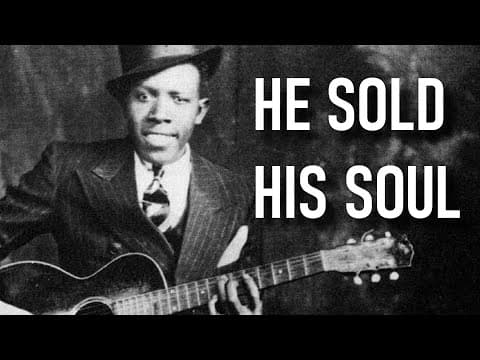
The most famous myth surrounding Johnson is that he sold his soul to the devil at a crossroads in exchange for musical talent. According to the legend, he played his guitar until midnight, at which point the devil appeared, tuned his guitar, played a song, and returned it to Johnson, marking the beginning of his transformation into a master guitarist. This tale, while far-fetched, highlights the dramatic improvement in Johnson's skills between 1930 and 1932, when he returned to perform for Sun House, astonishing everyone with his newfound talent.
After honing his craft, Johnson began traveling with fellow artist Johnny Shines, further refining his skills. In November 1936, he recorded his first songs for ARC Records, continuing to record until the summer of 1937. Despite his dark lyrical themes, which included references to hell, the devil, and death, Johnson's music was not widely recognized during his lifetime. His songs, such as "Me and the Devil Blues" and "Crossroad Blues," explored the struggles and hardships of life, resonating deeply with the blues genre.
On August 16, 1938, Robert Johnson was found dead at the age of 27, marking him as a member of the infamous 27 Club. The circumstances surrounding his death remain unclear, with various theories proposed. The most plausible explanation is that he died from untreated syphilis, a common affliction at the time. However, another theory suggests he was murdered after flirting with a married woman at a dance. Allegedly, her husband offered Johnson a drink that may have been poisoned, leading to his untimely demise.
For two decades after his death, Johnson remained relatively unknown. However, in 1961, Columbia Records released "King of the Delta Blues Singers," a compilation of his work that achieved immense success and solidified his status as a blues legend. His music began to influence a new generation of artists, and he was posthumously awarded a Grammy in 1990 for Best Historical Album. His song "Crossroad Blues" was inducted into the Grammy Hall of Fame, and he was inducted into the Rock and Roll Hall of Fame in 1986.
Robert Johnson may not have literally sold his soul to the devil, but he undoubtedly gave his soul to the blues. His brief yet impactful career changed the landscape of blues music forever, influencing countless musicians, including Mick Jagger, Fleetwood Mac, Bob Dylan, and Eric Clapton. Despite the historical inaccuracies and myths surrounding his life, one fact remains clear: Robert Johnson was a legend whose music continues to inspire and resonate with audiences today. His story is a testament to the power of perseverance and the enduring legacy of a true musical icon.