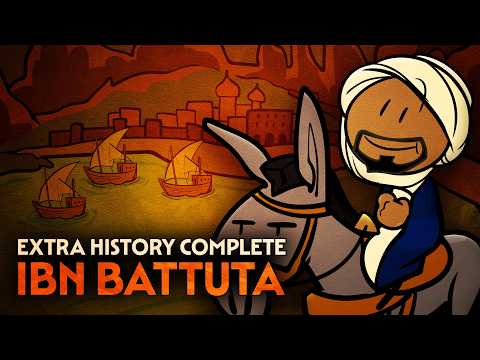
Ibn Battuta, a 14th-century Moroccan scholar, embarked on a 24-year journey across the Muslim world, covering 75,000 miles and experiencing diverse cultures, political upheavals, and personal adventures. His travels, documented in 'The Travels,' provide a unique insight into the Islamic world of his time, showcasing the interconnectedness of cultures and the impact of historical events like the Black Plague.
On June 23rd, 1325, a 21-year-old scholar named Ibn Battuta left his home in Tangier, Morocco, embarking on a journey that would last 24 years. His initial goal was to reach the holy city of Mecca, expecting to be gone for two to three years. However, he had no idea that this journey would become one of the most remarkable travel stories in history, covering nearly the entire Muslim world of the 14th century.
Ibn Battuta set out alone, driven by a deep desire to visit sacred places. He later reflected on his departure, saying, "I set out alone, having neither fellow traveler in whose companionship I might find cheer nor caravan whose part I might join." His travels would take him approximately 75,000 miles, enough to circle the globe three times, and he would meet 60 heads of state and visit 40 modern countries.
During his journey, Ibn Battuta faced numerous challenges, including kidnappings, shipwrecks, and the horrors of the Black Plague. Upon his return, he was commissioned by the ruler of Morocco to dictate his experiences, resulting in the book "A Gift to Those Who Contemplate the Wonders of Cities and the Marvels of Traveling," commonly known as "The Travels." This work, though lengthy, provides invaluable insights into the Islamic culture and trade networks of the time.
Ibn Battuta's formative years in Tangier, a significant trade hub, prepared him for his extensive travels. His family were scholars of Islamic law, and he received an education that allowed him to become a qadi, or judge, which would enable him to find work in various Muslim communities. His upbringing instilled in him a curiosity that was considered a religious duty in Islam, as reflected in the saying, "Seek knowledge even unto China."
Ibn Battuta's travel experience began with the Hajj, the annual pilgrimage to Mecca, which is a religious obligation for Muslim men. He initially traveled alone but soon joined a caravan for safety. His journey took him through North Africa, where he encountered various cultures and practices, including a brief marriage that ended in divorce. His travels were marked by a mix of personal experiences and observations of the societies he encountered.
As he traveled, Ibn Battuta encountered different interpretations of Islam and cultural practices. His experiences in Egypt, for instance, revealed his judgmental nature when he reported on the behavior of men in a bathhouse. His role as a qadi allowed him to navigate disputes within the caravan, showcasing his legal expertise.
After a series of adventures, including surviving illnesses and revolts, Ibn Battuta finally reached Mecca. He participated in the rituals of the Hajj, which deepened his spiritual journey and fueled his desire to explore further. News of the Sultan of Delhi's need for officials prompted him to extend his travels eastward.
Ibn Battuta's travels took him through Persia and Baghdad, where he witnessed the remnants of once-great cities. He encountered Sufi mystics and experienced the diverse expressions of Islam. His journey to India was marked by both adventure and danger, including a harrowing experience where he was nearly captured by rebels.
Upon arriving in Delhi, Ibn Battuta was appointed as a qadi by Sultan Muhammad Tughluq. His time in Delhi was filled with both privilege and peril, as the Sultan's erratic behavior and violent tendencies created a tense atmosphere. Despite the challenges, Ibn Battuta enjoyed a lavish lifestyle, but he soon found himself entangled in the Sultan's political machinations.
As the Black Plague swept through the region, Ibn Battuta witnessed the devastation it wrought on cities and populations. His travels became increasingly fraught with danger, and he sought refuge in various places, including a retreat in a cave. Eventually, he was summoned back to court, where he had to navigate the Sultan's unpredictable temperament.
Ibn Battuta's journey eventually led him back to Mecca for the Hajj one last time. After years of travel, he returned to Tangier, only to find that his mother had passed away. His later years included serving as an ambassador to the Mali Empire and dictating his travels, which would become a crucial historical document.
Ibn Battuta's life and travels offer a fascinating glimpse into the interconnected world of the 14th century. His experiences highlight the diversity of cultures within the Islamic world and the impact of historical events on society. Today, Ibn Battuta is celebrated as one of history's greatest travelers, inspiring countless others to explore the world.