
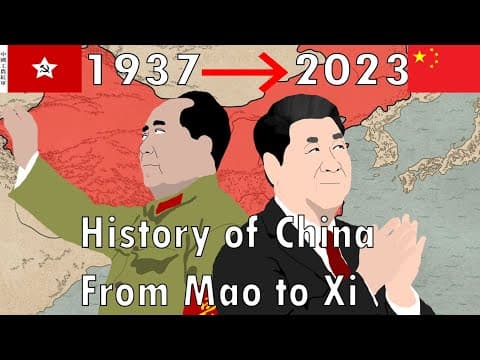
This comprehensive overview traces the history of China from the era of Mao Zedong through to Xi Jinping, highlighting key events, political shifts, and the evolution of the Chinese state, including the rise of communism, the Cultural Revolution, economic reforms, and contemporary challenges.
The history of modern China is a complex tapestry woven with threads of revolution, reform, and resilience. This post explores the significant events and transformations that have shaped China from the era of Mao Zedong to the current leadership of Xi Jinping.
Throughout the 1920s, China was fragmented and divided among various warlords. In 1929, Chiang Kai-shek and the Kuomintang (KMT) managed to unite most of the country with the help of allied warlords. However, this consolidation of power was met with resistance, leading to a civil war sparked by tensions in Hunan. The KMT's attempts to centralize authority faced significant opposition from former allies and regional warlords, culminating in the Central Plains War.
As the KMT struggled to maintain control, the Communist Party, led by Mao Zedong, began to establish its own bases across the country. Mao's focus on mobilizing peasants rather than workers set him apart from other Communist leaders. The Long March (1934-1935) solidified Mao's leadership and the Communist Party's resolve, allowing them to regroup and gain support.
The outbreak of the Second Sino-Japanese War in 1937 shifted the focus of both the KMT and the Communists. Despite initial setbacks, the Chinese resistance grew, and the war ultimately weakened both the KMT and Japan. The conflict resulted in significant loss of life and destruction, but it also laid the groundwork for the eventual resurgence of the Communist Party.
After World War II, the civil war between the KMT and the Communists reignited. The Communists, benefiting from popular support and military strategy, ultimately defeated the KMT in 1949, leading to the establishment of the People's Republic of China (PRC) under Mao's leadership. The KMT retreated to Taiwan, where they continued to claim legitimacy as the government of China.
Mao's rule was marked by radical policies aimed at transforming Chinese society. The Great Leap Forward (1958-1962) aimed to rapidly industrialize the country but resulted in a catastrophic famine that claimed millions of lives. The Cultural Revolution (1966-1976) sought to purge capitalist and traditional elements from Chinese society, leading to widespread chaos, persecution, and violence.
Following Mao's death in 1976, China entered a period of transition. Deng Xiaoping emerged as a key leader, advocating for economic reforms that shifted the country towards a market-oriented economy. The introduction of Special Economic Zones (SEZs) in the 1980s marked a significant turning point, allowing for foreign investment and economic growth.
In 1989, widespread protests erupted in Tiananmen Square, driven by demands for political reform and greater freedoms. The government's violent crackdown on the protests resulted in significant loss of life and marked a turning point in China's political landscape, leading to increased repression and censorship.
Xi Jinping's ascent to power in 2012 marked a new era for China. His leadership has been characterized by a consolidation of power, a focus on national rejuvenation, and an assertive foreign policy. Xi's administration has faced criticism for human rights abuses, particularly in Xinjiang and Tibet, as well as for its handling of dissent and freedom of expression.
The history of China from Mao to Xi is a story of transformation, marked by struggles for power, ideological battles, and significant social changes. As China continues to navigate its path on the global stage, the legacy of its past remains a crucial factor in shaping its future.



















