
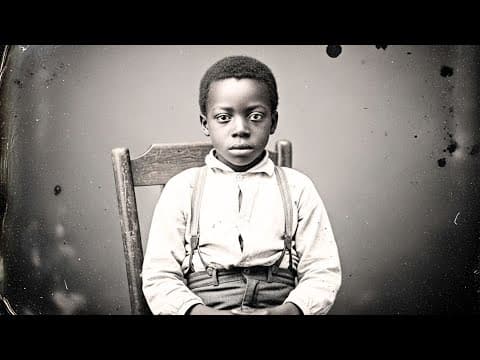
Samuel Carter, a 7-year-old black boy in 1859 Louisiana, exhibited extraordinary intelligence and abilities that baffled science and terrified society. Documented by Dr. Elizabeth Monroe, his story reveals a gifted child who predicted deaths, exposed cruelty, and challenged racial prejudices during slavery. His legacy raises profound questions about human potential, justice, and the silenced brilliance of black minds in history.
In the autumn of 1859, in the isolated village of Meow Creek, Louisiana, a 7-year-old black boy named Samuel Carter became the center of one of the most bewildering and terrifying medical cases documented in the American South before the Civil War. Dr. Elizabeth Monroe, the only formally trained physician in the region, recorded detailed observations about Samuel, whose intelligence defied the scientific understanding of the era.
Samuel Carter was born in 1852 on the Witmore plantation, one of the largest cotton operations in Ascension Parish. His mother, Esther Carter, was a house servant who secretly taught him to read despite laws forbidding literacy among enslaved people. Samuel's father was sold away early in his life, and his mother died when he was just four years old.
From a young age, Samuel exhibited extraordinary knowledge and abilities. He claimed to hear voices from the swamp that whispered secrets, revealed hidden truths, and foretold imminent deaths. He knew detailed anatomical information and intimate secrets of people he had never met.
Samuel described the voices as coming from the swamp, where the dead lingered with unfinished business. These voices guided him, revealing truths about people’s lives and impending deaths. His knowledge was so precise that it led to the discovery of crimes and injustices that had otherwise remained hidden.
Nine people died under mysterious circumstances after interacting with Samuel. Each was found with eyes wide open, as if they had witnessed something beyond human comprehension. These deaths included individuals known for cruelty, such as a plantation owner who had killed children, a reverend profiting from the slave trade, and a judge who upheld slavery laws.
Dr. Monroe, a rare female physician trained in Philadelphia, took Samuel into her care after he was sold to a slave trader who died mysteriously. She treated him not as a slave or servant but as a subject of medical study, documenting his abilities meticulously in leatherbound journals.
Despite her scientific training, Dr. Monroe struggled to explain Samuel’s gifts through conventional means. She observed his uncanny ability to describe anatomy, predict illnesses, and reveal personal secrets. She theorized that Samuel might possess a form of extrasensory perception or be in contact with something beyond the material world.
Samuel’s abilities terrified white society, challenging the racist beliefs that justified slavery. Many white residents feared him, while the enslaved community saw him as an avenging angel or prophet. Old Jeremiah, a former enslaved man, explained to Samuel that his gift was part of ancestral traditions passed down from Africa, a connection to spiritual powers that slavery sought to erase.
Samuel’s story did not end in Maro Creek. Reports of a black man with similar extraordinary abilities appeared in northern states during and after the Civil War. He was said to have helped the Underground Railroad, worked as a scout for Union forces, and documented racial violence and massacres, bearing witness to atrocities often erased from official history.
Samuel Carter disappeared after 1899, but his legend persisted in black communities as a symbol of justice, memory, and resilience. Dr. Monroe’s journals, sealed for decades, became subjects of academic study, raising more questions than answers about human perception and consciousness.
Samuel’s story challenges us to reconsider the limits of human potential and the countless brilliant black minds silenced by oppression. Whether his voices were supernatural or a profound human sensitivity to injustice, Samuel Carter’s life remains a powerful testament to intelligence, courage, and the enduring quest for truth and justice.
Dr. Monroe concluded that Samuel Carter was proof that black people possessed intelligence and capabilities that society refused to acknowledge. His existence challenged the foundations of racial hierarchy and slavery. His story reminds us of the many gifted individuals whose potential was crushed by systemic oppression.
Samuel Carter’s legacy is not just about unexplained phenomena but about the human spirit’s resilience and the pursuit of justice in the face of unimaginable adversity.
What do you think about Samuel Carter’s story? Was he truly gifted with supernatural abilities, or did he possess a form of human perception still beyond our understanding? Share your thoughts and stories about extraordinary ancestors who defied explanation.
The voices they tried to silence are the voices we must amplify. The stories they tried to erase are the stories we must tell loudest.



















