
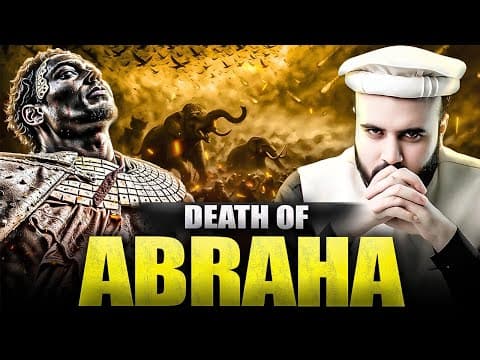
This blog post explores the historical context and events surrounding Abraha's failed attack on the Kaaba, detailing his motivations, military actions, and the miraculous events that led to the defeat of his forces.
The story of Abraha's attack on the Kaaba is a significant event in Islamic history, illustrating the clash between power, faith, and divine intervention. This blog post delves into the motivations behind Abraha's actions, the military campaign he launched, and the miraculous events that led to his downfall.
Abraha, a ruler from Yemen, harbored a deep-seated hatred for the Kaaba, which had become the most sacred site for Arabs. People from all over Arabia traveled to Mecca for pilgrimage, generating substantial wealth for the local inhabitants. This prosperity angered Abraha, who felt that the people of Mecca, without any king or government, should not hold such a central position in the Arabian Peninsula.
To counter this, Abraha constructed a grand church in his capital, Sana, hoping to divert pilgrims from the Kaaba to his new establishment. However, this project failed miserably, leaving him with only one option: to destroy the Kaaba.
Abraha was not born into royalty; he was a slave from a small town in the Roman Empire. The ongoing conflict between Yemen, dominated by Jews, and Abyssinia, populated by Christians, set the stage for his rise. After a series of violent confrontations, the Roman Empire intervened, sending Abraha with an army of 100,000 soldiers to eliminate the Jewish kingdom in Yemen. Following his victory, Abraha gained immense power and separated Yemen from Abyssinia, becoming a formidable ruler in the region.
In an attempt to rival the Kaaba, Abraha built an opulent church filled with jewels and precious stones, the most magnificent structure in Arabia at the time. Despite its grandeur, no one came to worship there, as the people continued to flock to the Kaaba. Frustrated by this failure, Abraha decided to take drastic measures.
Gathering an army of 60,000 soldiers, Abraha set out to attack the Kaaba. Historical records, including ancient Arabic inscriptions, confirm that this event was significant not only in Islamic history but also in the broader context of regional power struggles. However, there is little mention of his actual arrival in Mecca in these records.
Upon reaching Mecca, Abraha summoned the chief of the Quraysh tribe, Abdul Muttalib, to negotiate. Abdul Muttalib requested the return of his camels that had been seized by Abraha. In a moment of bravado, Abraha mocked him, questioning why he was concerned about his camels when he should be defending the Kaaba. Abdul Muttalib responded calmly, stating that he was only the owner of the camels, while the Kaaba had a protector far greater than himself.
The next day, Abraha ordered his troops to attack the Kaaba. However, his war elephant, which was supposed to lead the charge, refused to move. At that moment, a flock of birds appeared in the sky, each carrying a stone in their beaks. These birds, described in historical accounts as never seen before or after that day, began to target Abraha's soldiers, dropping stones that caused devastating injuries.
Historians have speculated that this event may have been akin to a severe outbreak of smallpox, as the stones caused the soldiers to suffer extreme reactions, leading to their retreat. Abraha's once-mighty army of 60,000 was decimated, and he was forced to flee.
The news of Abraha's defeat spread throughout Arabia, elevating the Quraysh tribe to a position of power. Following this event, the pilgrimage to the Kaaba increased significantly, with millions flocking to the site each year. The wealth of Mecca surged, and the annual Okaz fair became a major event.
In a remarkable twist of fate, the same year that Abraha's forces were defeated, a significant event occurred in Persia: the fire in the largest temple extinguished after years of burning. On that very day, a child was born in Mecca, who would later be known as Muhammad, the Prophet of Islam.
The story of Abraha's failed attack on the Kaaba is not just a tale of military defeat but a profound narrative of faith, resilience, and divine intervention. It highlights the significance of the Kaaba in the Arabian Peninsula and sets the stage for the rise of Islam, marking a pivotal moment in history that continues to resonate today.



















