
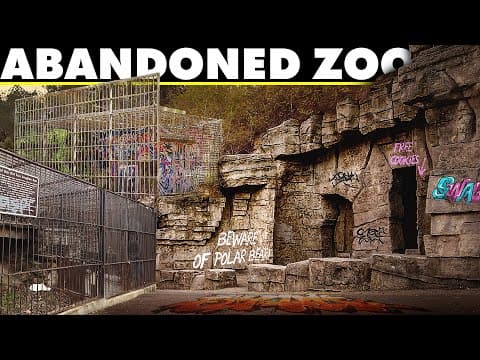
The old Griffith Park Zoo in Los Angeles, built in 1912, was the city's first attempt at a zoological garden but faced many challenges due to poor design, lack of expertise, and inadequate funding. Despite renovations during the New Deal era, it became outdated and was replaced by the modern LA Zoo in 1966. Today, the abandoned zoo remains a unique urban ruin and public picnic area, reflecting LA's cultural evolution.
Griffith Park, sprawling over 4,000 acres above the hills of Los Angeles, is famous for landmarks such as the Hollywood Sign, the Griffith Observatory, and the Los Angeles Zoo. However, nestled in one of its quieter valleys lies a lesser-known but intriguing site: the old abandoned Griffith Park Zoo. This complex of empty cages and artificial rock formations stands as one of California's most unusual ruins, telling a story of ambition, challenges, and transformation.
The concept of keeping animals for public viewing dates back thousands of years. In ancient civilizations, exotic creatures symbolized power and dominion. Pharaohs collected lions and baboons, Chinese emperors curated predators to showcase their empire's reach, and European kings displayed hunting trophies as tokens of conquest. These collections were private, reserved for royalty and the elite.
By the 18th and early 19th centuries, a shift occurred. With the rise of scientific curiosity and industrial expansion in Europe, aristocratic collections evolved into zoological gardens accessible to the public. London's Regent Park Zoo opened in 1828, followed by Paris's expansion of its gardens into public attractions. This idea spread globally as societies sought to understand the natural world and their place within it.
By the mid-1800s, American cities embraced zoos as markers of cultural legitimacy, aspiring to surpass European standards. Cities like New York, Philadelphia, Cincinnati, and Boston established zoological parks that combined entertainment, education, and civic pride.
Southern California's journey toward a proper zoo was more modest. Before the establishment of a formal zoo, Los Angeles maintained a loose collection of animals at East Lake Park (now Lincoln Park). This collection included bears, deer, small carnivores, and occasionally exotic animals donated or acquired through informal means such as traveling circuses or private collectors.
Transporting animals to Los Angeles was challenging due to its geographic isolation. Many animals endured long, stressful journeys by rail across the Southwest, with some not surviving the trip. Despite these hardships, the city’s desire for cultural stature intensified alongside its explosive growth at the turn of the 20th century.
In 1896, Griffith J. Griffith donated over 3,000 acres of rugged land to Los Angeles, intended as a park. Much of this land remained undeveloped for years, but many saw it as an ideal location for a zoo. By the early 1900s, newspapers, educators, and city officials echoed the sentiment that Los Angeles needed a proper zoological garden.
Two major obstacles stood in the way: funding and expertise. Nevertheless, public pressure led city leaders to approve the construction of a new zoo within Griffith Park in 1912. Due to limited resources and lack of professional zoological guidance, the zoo was built cheaply using recycled fencing, cast-off lumber, and unevenly poured concrete on rugged terrain. Despite its crude construction, Los Angeles finally had a zoo.
Filling the cages proved difficult. Animals were sourced from East Lake Park, transported in wooden crates on flatbed wagons, or brought by rail from the Midwest and beyond. Some local wildlife, such as bears and mountain lions, were captured and sold to the city, while traveling circuses occasionally sold older exotic animals.
The public initially loved the novelty of the zoo, thrilled to see live monkeys and other exotic creatures. However, animal welfare was not a primary concern at the time. Behind the scenes, conditions were harsh: enclosures were cramped, poorly drained, and trapped heat during summer months. Veterinary care was minimal, with keepers relying on guesswork. Illnesses often went untreated, diets were improvised, and sanitation was subpar.
By the 1930s, the zoo's problems became too serious to ignore. Public concern grew as visitors noticed the deteriorating conditions. The Works Progress Administration (WPA), part of the New Deal, provided labor to renovate the zoo, aiming to give it a more naturalistic appearance. The Bear Grotto became a major attraction, and monkey cages were redesigned to look more orderly.
Despite these efforts, the fundamental flaws remained. The zoo's footprint was too small, and the facilities were outdated. Staffing levels were insufficient to meet modern standards. Meanwhile, zoos nationwide were adopting larger, natural habitats and establishing dedicated veterinary programs. Los Angeles lagged behind, and photographs from the era showed lions pacing in concrete grooves and stressed bears and primates confined to iron bars.
Public interest waned, attendance dropped, and funding stagnated. Critics called for change, and city officials decided to relocate the zoo.
Once relocation was approved, planning moved swiftly. A flatter section of Griffith Park was selected for the new zoo, and architects designed facilities based on modern zoological principles. Larger paddocks and a central veterinary building were constructed.
Animals were carefully transferred over several weeks, often before dawn to minimize stress and public attention. Lions were sedated and transported in steel-lined crates, bears were guided with food rewards, and primates were moved in small groups. After the transfer, the old Griffith Park Zoo was locked and abandoned.
The new Los Angeles Zoo opened in 1966, hailed as a fresh start that brought the city up to contemporary standards.
Following its closure, the old zoo site was left untouched. By the 1970s, it became an unofficial destination for urban explorers. The city did not intervene despite increasing foot traffic. Over time, graffiti covered the rock walls, broken glass and beer cans littered the animal pits, and fires were occasionally lit in tunnels.
In the 1980s and 1990s, artists and photographers embraced the site’s unique blend of nature and decay. Its reputation grew, attracting film crews and mainstream visitors. By the 2000s, the old zoo had evolved into a makeshift picnic area, a role it officially maintains today.
The abandoned Griffith Park Zoo stands as a fascinating urban ruin that reflects Los Angeles’s cultural and historical evolution. From its humble and troubled beginnings as the city’s first zoo to its rebirth as a modern zoological facility, the old zoo’s story is one of ambition, challenge, and transformation. Today, it invites visitors to explore a unique blend of history, nature, and art, preserving a piece of Los Angeles’s past in the heart of Griffith Park.
This story highlights how urban spaces can evolve and how cultural aspirations shape city landscapes over time. The old Griffith Park Zoo remains a testament to Los Angeles’s journey toward becoming a major American metropolis.



















