
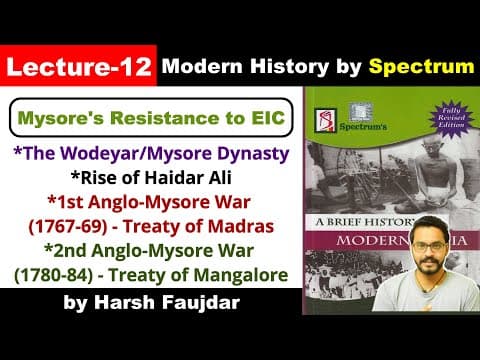
This blog post explores the historical context and events surrounding the First and Second Anglo-Mysore Wars, focusing on the rise of Haidar Ali and the Wodeyar Dynasty in Mysore, detailing the geopolitical dynamics, key battles, and treaties that shaped this period in Indian history.
In the realm of modern history, the conflicts between the British East India Company and the Kingdom of Mysore stand out as significant events that shaped the political landscape of South India. Following the British victories in Bengal, the East India Company shifted its focus southward, where the powerful state of Mysore was emerging under the Wodeyar dynasty. This blog post delves into the First and Second Anglo-Mysore Wars, highlighting the rise of Haidar Ali and the geopolitical dynamics of the time.
The Wodeyar dynasty, which ruled Mysore, was established in 1612 after the disintegration of the Vijayanagar Empire, a powerful state that existed from 1336 until its decline in 1565. The defeat of the Vijayanagar Empire at the Battle of Talikota marked the beginning of the emergence of smaller kingdoms, including Mysore.
During the time of Haidar Ali's rise, Mysore was surrounded by several powerful entities: the Maratha Empire to the west, the Nizam of Hyderabad to the north, and the British influence in Madras to the east. The control of the Malabar Coast was crucial for trade, and the East India Company was concerned about the growing power of Mysore, fearing it would disrupt their trade routes.
Haidar Ali, born in 1721, began his career as a horseman in the Mysore army. By 1760, he had risen to become the de facto ruler of Mysore. His diplomatic skills and awareness of the geopolitical landscape allowed him to consolidate power effectively. As he strengthened Mysore, he formed alliances with the French, which alarmed the British.
The First Anglo-Mysore War was triggered by the East India Company's desire to curb Haidar Ali's growing influence. The British formed alliances with the Marathas and the Nizam of Hyderabad to counter Haidar Ali. The conflict began in 1767.
Haidar Ali, using his diplomatic acumen, managed to neutralize the Marathas by offering them financial incentives to stay out of the conflict. This left the British to face him alone. The war concluded with the Treaty of Madras in 1769, which established a mutual defensive alliance between Haidar Ali and the British, ensuring that both parties would assist each other against external threats.
The Treaty of Madras included provisions for mutual defense and the restitution of territories captured during the war. This treaty marked a significant victory for Haidar Ali, showcasing his military prowess against the British.
Despite the Treaty of Madras, tensions remained high. In 1771, the Marathas attacked Haidar Ali, and the British did not come to his aid, leading to a breach of the treaty. Meanwhile, Haidar Ali's relationship with the French strengthened, further aggravating the British.
The Second Anglo-Mysore War began in 1780 when the British attacked the French-controlled port of Mahe, which was under Haidar Ali's protection. This prompted Haidar Ali to retaliate, leading to a renewed conflict.
Haidar Ali initially achieved success, capturing Arcot and defeating British forces. However, the British regrouped and eventually defeated him at Port Nova in 1781. Haidar Ali's health deteriorated, and he passed away from cancer in December 1782.
The war continued under the leadership of his son, Tipu Sultan, until both sides agreed to a peace treaty in March 1784, known as the Treaty of Bangalore. This treaty restored territories captured during the war and marked the end of the Second Anglo-Mysore War.
The First and Second Anglo-Mysore Wars were pivotal in shaping the future of South India. Haidar Ali's rise to power and his confrontations with the British East India Company highlighted the complexities of regional politics and the struggle for dominance in the subcontinent. The legacy of these conflicts continued with Tipu Sultan, who became a significant figure in Indian history, symbolizing resistance against colonial rule. Understanding these wars provides valuable insights into the historical dynamics that influenced India's path toward independence.



















