
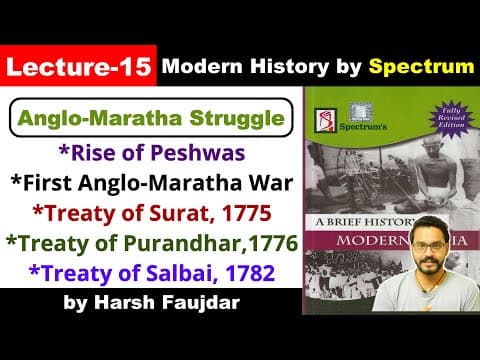
The First Anglo-Maratha War (1775-1782) was a significant conflict that arose from the power struggles within the Maratha Empire and the British East India Company's ambitions in India. This blog post explores the rise of the Peshwas, the Treaty of Salbai, and the events leading to the war, highlighting key figures and battles that shaped this period in Indian history.
The First Anglo-Maratha War (1775-1782) marked a pivotal moment in Indian history, characterized by the power struggles within the Maratha Empire and the increasing influence of the British East India Company. This blog post delves into the events leading up to the war, the rise of the Peshwas, and the eventual Treaty of Salbai.
Shivaji Maharaj, the founder of the Maratha Empire, passed away in 1680, leaving a significant political vacuum. His legacy was challenging to uphold, and after his death, his son Sambhaji took over. However, Sambhaji faced constant struggles against the Mughal Empire and was eventually executed by Aurangzeb. Following this, Shahaji, Sambhaji's son, was captured, leading to a brief rule by his brother Rajaram, who also died shortly after.
In the absence of a rightful heir, Tarabai, the widow of Rajaram, began to rule on behalf of her minor son, Shivaji II. This led to a succession war between Tarabai and Shahaji, who had been released after Aurangzeb's death in 1707. The conflict divided the Maratha leaders, with some supporting Tarabai and others backing Shahaji.
Shahaji emerged victorious in the succession war with the help of the Peshwas, a council of eight officers responsible for Maratha administration. The Peshwas became a powerful force in Maratha politics, especially after Balaji Vishwanath was appointed as the Peshwa in 1713. He established the hereditary nature of the Peshwa position, ensuring that his successors would inherit the title.
Balaji Vishwanath played a crucial role in strengthening the Maratha Empire. He assisted Shahaji in the Battle of Kheda, leading to a significant victory. His tenure saw the expansion of Maratha influence, and he successfully negotiated with the Mughal Empire, securing revenue collection rights in various territories.
After Balaji Vishwanath's death in 1720, his son Baji Rao I became the Peshwa. Baji Rao I is often regarded as the real founder of Peshwa power, expanding the Maratha Empire significantly during his rule until 1740. His military campaigns reached as far as Delhi, and he united various Maratha factions under his leadership.
During this period, the Mughal Empire was in decline, with Emperor Muhammad Shah unable to maintain control. The Marathas capitalized on this weakness, further solidifying their power in India.
The Maratha Empire faced internal challenges after the death of Baji Rao I in 1740, leading to a succession of Peshwas, including Balaji Baji Rao (Nana Sahib). The Marathas' obligations to protect the Mughals from foreign invasions, as per treaties signed, became a point of contention, especially during the Third Battle of Panipat in 1761, where the Marathas suffered a devastating defeat.
In 1775, Raghunath Rao, a rival claimant to the Peshwa title, sought British support to claim the position. This led to the signing of the Treaty of Surat, which granted the British significant economic privileges in exchange for military support. However, this treaty was condemned by the British Kolkata Council, leading to further complications.
The conflict escalated into the First Anglo-Maratha War, marked by battles between the British and Maratha forces. The British, under the leadership of various governors, sought to expand their influence while the Marathas aimed to maintain their sovereignty.
The war saw several key battles, including the Battle of Wadgaon in 1779, where the Marathas emerged victorious. This led to the Treaty of Wadgaon, which aimed to restore territories captured by the British. However, the British Governor-General, Warren Hastings, rejected this treaty, leading to continued hostilities.
The war concluded with the Treaty of Salbai in 1782, which established a mutual agreement between the British and the Marathas. The treaty recognized the British control over Salsette while returning other territories to the Marathas. This treaty marked a significant turning point, as it established a period of peace between the two powers for the next two decades.
The First Anglo-Maratha War was a complex conflict rooted in the power struggles of the Maratha Empire and the ambitions of the British East India Company. The rise of the Peshwas and the subsequent treaties shaped the political landscape of India, setting the stage for future conflicts and the eventual dominance of British colonial rule. Understanding this period is crucial for comprehending the historical dynamics that influenced modern India.



















