
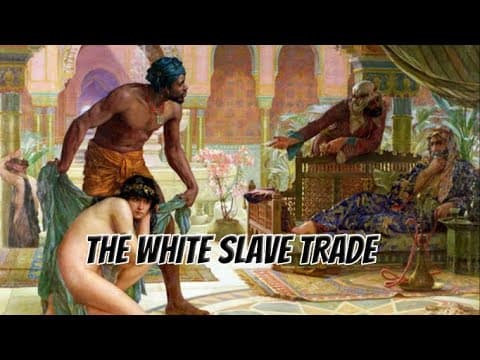
This blog post explores the historical context of the white slave trade, particularly focusing on the Barbary pirates and the American military intervention led by Thomas Jefferson, which aimed to end the enslavement of American sailors and others by these pirates in the early 19th century.
Slavery has been a part of human civilization since ancient times, existing in various forms across cultures and continents. While the transatlantic slave trade involving African slaves is often the focus of discussions about slavery, there is a lesser-known aspect known as the white slave trade, particularly involving the Barbary pirates of North Africa. This blog post delves into this forgotten history, the American response, and the implications of these events.
Slavery, in its many forms, has been practiced throughout history. The most recognized form is the African slave trade, which saw millions of Africans forcibly transported to the Americas between the 1500s and the mid-1800s. Estimates suggest that between 10 to 13 million Africans were brought to the New World, with around 10 million surviving to be sold in various colonies. Notably, Brazil received nearly 5 million slaves, while the British, French, and Spanish colonies in North America and the Caribbean accounted for about 450,000.
Despite the abolition of the transatlantic slave trade, slavery persists in various forms today. However, a significant yet often overlooked chapter in the history of slavery is the white slave trade, which was particularly active in the late 18th and early 19th centuries.
During the late 1700s and early 1800s, the Barbary pirates from North Africa were notorious for capturing ships and enslaving their crews. These pirates targeted not only European vessels but also American merchant ships, especially after the United States gained independence and lost the protection previously afforded by Great Britain.
The Barbary Coast pirates operated under Islamic law, which permitted the enslavement of non-Muslims. Over a span of more than 300 years, it is estimated that around one million Europeans were enslaved, many of whom were captured at sea. The pirates demanded ransoms for the release of their captives, leading to significant financial burdens on nations, including the United States.
As the third president of the United States from 1801 to 1809, Thomas Jefferson faced numerous challenges, including the ongoing threat from the Barbary pirates. In 1806, he condemned the international slave trade and called for its criminalization, leading to the Act Prohibiting Importation of Slaves in 1807. However, the issue of piracy and the enslavement of Americans remained unresolved.
Jefferson's administration marked a turning point as he became the first president to send military forces overseas in direct action against the Barbary pirates. The conflict began when the Pasha of Tripoli declared war on the United States in 1801, prompting Jefferson to respond with military force.
In response to the declaration of war, Jefferson dispatched a naval fleet to the Mediterranean. Commodore Richard Dale led the initial show of force, blocking the Pasha's corsairs and protecting American shipping. The situation escalated, leading to further military actions, including the famous raid led by Lieutenant Stephen Decatur, who destroyed the captured USS Philadelphia to prevent its use by the pirates.
In 1805, Jefferson authorized a daring land campaign led by former consul William Eaton and U.S. Marine Corps First Lieutenant Presley O'Bannon. They aimed to capture the city of Derna and free American hostages. This expedition involved a diverse group of mercenaries, including Greeks, Arabs, and Berbers, who were united by their shared goal of ending the white slave trade.
The campaign culminated in the Battle of Derna, where O'Bannon and his Marines played a crucial role. Despite being outnumbered, they successfully captured the city, marking the first time an American flag was raised on foreign soil. This victory not only freed hostages but also dealt a significant blow to the Barbary pirates' operations.
Following the battle, a peace treaty was signed, granting American ships safe passage through the Mediterranean without the need for tribute payments. This marked a significant shift in the dynamics of power in the region and contributed to the decline of the white slave trade.
The intervention against the Barbary pirates and the white slave trade is a pivotal yet often overlooked chapter in American history. Jefferson's actions not only protected American interests but also contributed to the broader fight against slavery in all its forms. The legacy of this conflict continues to resonate, reminding us of the complexities of history and the ongoing struggle against human trafficking and slavery in the modern world.



















