
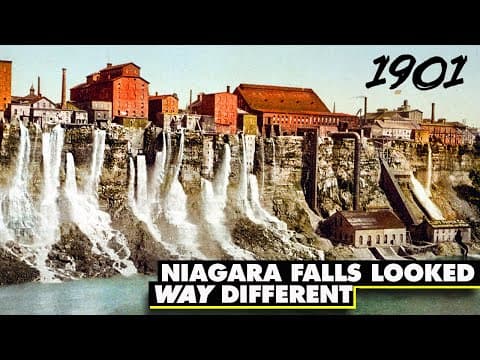
Niagara Falls, known for its breathtaking beauty, once thrived as an industrial powerhouse that fueled economic growth and innovation. This blog post explores the region's transformation from a sacred indigenous site to a hub of industrial activity, its subsequent decline, and the ongoing efforts to revitalize its historical significance.
When you think of Niagara Falls, stunning vistas and booming cascades likely come to mind. However, beneath this natural beauty lies a forgotten chapter of American history, where the roar of the falls was not just a natural wonder but the heartbeat of an industrial empire. For over a century, Niagara Falls was not only a global tourist destination but also a key industrial powerhouse that fueled factories, mills, and entire industries, turning the city beside it into a beacon of innovation and economic growth.
Before becoming an industrial powerhouse, the Niagara Falls region was a natural landscape shaped by the relentless flow of water over thousands of years. Erosion carved out an ecosystem where the power of the Niagara River dictated life in the area. The Niagara River flows from Lake Erie to Lake Ontario, forming the boundary between New York and Ontario, and spans approximately 36 miles. This river is a vital component of the Great Lakes water system, carrying water from the upper lakes towards the St. Lawrence River, which eventually empties into the Atlantic Ocean.
Before European settlers arrived, the region was dominated by temperate hardwood forests and was home to various wildlife species. The indigenous peoples, particularly the Neutral Nation, inhabited the area, strategically placing settlements along the Niagara River. They played a crucial role in the fur trade, developing trade relations with other tribes and later with European settlers. For these tribes, Niagara Falls was more than just a natural wonder; it was a sacred site believed to be a portal between the physical and spiritual worlds.
The first Europeans to document Niagara Falls were French explorers in the 17th century. Samuel de Champlain referenced the falls in 1604, while Father Louis Hennepin became the first European to witness them in 1678. His accounts spread awareness of Niagara Falls throughout Europe, leading to increased interest in the region.
As European settlers recognized the river's potential for energy production, the landscape began to change. The Industrial Revolution in the late 18th century marked a significant shift, as the first factories emerged in the northeastern United States, utilizing rivers for reliable energy sources. By the late 18th century, small water-powered mills were built along the river, harnessing Niagara's current for various industrial purposes.
In 1882, the Niagara Falls Hydraulic Power and Manufacturing Company built the first hydroelectric power plant in the region. This facility operated using direct current, developed by Thomas Edison. However, the limitations of direct current led to a breakthrough in 1896 when Nikola Tesla and George Westinghouse implemented the first alternating current system at Niagara Falls. This innovation allowed electricity to be transmitted over long distances, validating the AC model for industrial-scale power distribution.
By the early 20th century, the Niagara Falls industrial district had transformed into a diverse industrial powerhouse. The demand for hydroelectric power skyrocketed, leading to the establishment of new hydroelectric plants on both the American and Canadian sides of the falls. The Niagara Falls Power Company consolidated multiple companies, enabling efficient electricity distribution.
The region attracted chemical giants and other industries, resulting in a population explosion and significant infrastructure development. Railroads were extended, and residential areas were improved, turning Niagara Falls into a key industrial hub in the north.
However, the rapid growth of Niagara Falls could not last forever. By the mid-20th century, global competition and technological advancements began to weaken the industrial sector. Companies relocated to regions with lower labor costs and relaxed environmental regulations, leading to a decline in local industries. The aluminum and chemical industries faced significant challenges, and many factories shut down or reduced production.
As industries left, the local economy collapsed, unemployment soared, and the city entered a period of decline. Abandoned buildings and factories became symbols of urban decay, and the once-thriving neighborhoods suffered from depopulation.
The industrial activities of Niagara Falls also left a lasting environmental impact. For decades, factories operated with little regulation, dumping chemical waste into the ground and the river. The Love Canal disaster, where toxic waste was buried and later contaminated residential areas, highlighted the severe consequences of industrial pollution. This incident led to federal emergency declarations and the establishment of the Superfund program to clean up hazardous waste sites.
Despite the decline, Niagara Falls has not disappeared entirely. Efforts to revitalize the city have emerged, leveraging its history, infrastructure, and natural beauty. Some former factories have been repurposed into historical centers, while others stand abandoned as reminders of a bygone era.
The Niagara Parks Power Station on the Canadian side has been restored and converted into an exhibition space, showcasing the region's industrial heritage. Various conservation projects aim to protect key structures, and educational tours highlight the city's role in major social movements.
Today, Niagara Falls has reinvented itself as a destination where history, technology, and tourism intertwine. The abandoned factories and industrial ruins serve as a reminder that the falls were once much more than just a natural wonder; they were a symbol of industrial power and national innovation.



















