
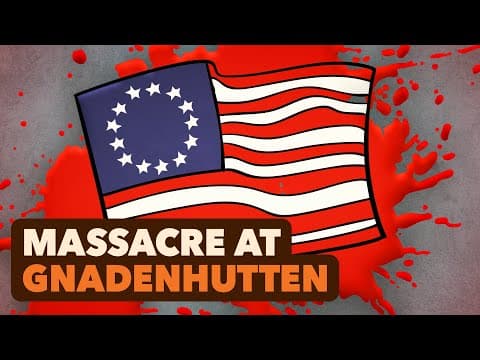
The Janaden Hutton massacre in 1782 highlights the brutal violence of the American Revolution, where a peaceful Moravian village was attacked by Pennsylvania militia. This event, often overlooked in history, reveals the darker truths of the conflict, including the suffering of Native Americans caught in the crossfire. The massacre serves as a reminder of the complexities and moral failings during the founding of the United States, urging us to remember these events to avoid repeating past injust
On March 6, 1782, in Janaden Hutton, Ohio, a young man named Joseph Shibash stumbled upon a group of armed men while searching for a stray horse. Recognizing them as members of the Pennsylvania militia, known for their hostility towards Native Americans, Shibash attempted to flee. Tragically, he was shot, captured, and brutally killed. This incident marked the beginning of one of the most horrific massacres of the American Revolution, a dark chapter often omitted from mainstream historical narratives.
The American Revolution was a complex and violent conflict, characterized by brutal engagements between British and Continental forces. While many accounts focus on military confrontations, the violence extended beyond the battlefield, affecting civilians, particularly Native Americans. During this period, massacres occurred, and the lines between military operations and atrocities often blurred.
Both British and American forces committed acts of extreme violence against each other, as seen in battles like Polloi Tavern and Waxhaws. However, the violence also spilled over into civilian life, with many innocent people suffering from theft, eviction, and assault. Although outright killings of civilians were rare, there were notable exceptions, with the Janaden Hutton massacre standing out as one of the bloodiest.
The Native American tribes faced immense challenges during the Revolution, often caught between the British and American forces. The Lenape tribe, for instance, found themselves displaced after the French and Indian War, with many settling in Ohio. Among them were the Moravian Indians, a group that adhered to pacifist beliefs and sought to remain neutral during the conflict. Unfortunately, their attempts to avoid involvement in the war only made them targets for both sides.
In September 1781, the British forced the Moravians to relocate closer to Detroit for protection. However, as food supplies dwindled, the British allowed them to return to their original villages. This decision led the revolutionary forces to suspect the Moravians of aiding the British, setting the stage for the tragic events that would follow.
On March 8, 1782, a group of 160 Pennsylvania militia members descended upon the Moravian village of Janaden Hutton. Initially claiming to protect the villagers, the militia soon revealed their true intentions. They bound the Moravians, separating men from women and children, and held a vote on whether to kill them. Only 18 out of 160 militiamen opposed the massacre.
As the sun rose, the militia began their brutal assault. Armed with mallets, hatchets, and knives, they murdered the bound Moravians indiscriminately, regardless of age or gender. The victims, while praying and singing hymns, were bludgeoned and scalped. In total, 28 men, 29 women, and 39 children were killed, with only two children surviving the massacre.
The news of the Janaden Hutton massacre spread quickly, eliciting mixed reactions among Colonial Americans. While some denounced the violence, many others either remained silent or supported the militia's actions. Benjamin Franklin expressed his pain over the incident but simultaneously propagated false narratives about British bounties on Colonial scalps, further inciting violence against Native Americans.
Despite the formal end of the American Revolution in 1783, violence against Native tribes continued as the United States expanded westward. The memory of the Janaden Hutton massacre fueled retaliatory strikes by Native Americans and contributed to ongoing conflicts throughout the 1780s and 90s.
Today, events like the Janaden Hutton massacre are often overshadowed by more prominent figures and battles in American history. However, understanding the full scope of the American Revolution, including its darker aspects, is crucial. The narratives we choose to remember shape our understanding of history and influence our present and future.
The Janaden Hutton massacre serves as a stark reminder of the violence and moral complexities that accompanied the founding of the United States. By acknowledging these events, we can learn from the past and strive to avoid repeating the mistakes that led to such tragedies. It is essential to confront the uncomfortable truths of history to foster a more comprehensive understanding of our nation's origins and the lessons they impart.



















