
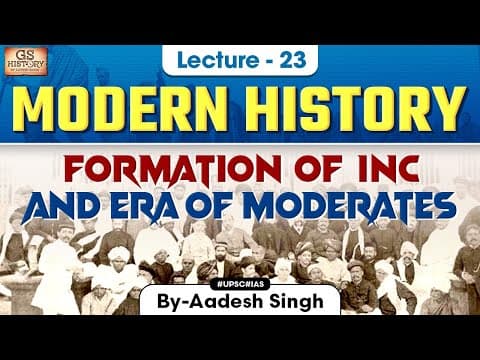
This blog post explores the formation of the Indian National Congress (INC) in 1885, its significance in the Indian freedom struggle, and the contributions of various leaders during the era of moderates, highlighting their demands for constitutional, economic, and administrative reforms.
In the previous discussion, we examined how nationalism began to take root in India following the 1857 revolution. Various political and social organizations emerged to expose British exploitation to the general public. This movement laid the groundwork for the Indian National Congress (INC), which would later lead the Indian freedom struggle. In this post, we will delve into the formation of the INC and its pivotal role in shaping Indian politics.
The Indian National Congress was destined to become the umbrella organization leading the Indian freedom struggle. However, the history of its formation is both interesting and controversial. Many historians attribute the credit for the INC's formation to a retired English civil servant, A.O. Hume, rather than Indian leaders. This argument is known as the "Safety Valve Theory."
The Safety Valve Theory posits that the British, having witnessed the 1857 revolution, recognized the potential for major rebellions due to the political situation in India. To avoid such tensions, they sought to provide Indians with a political platform to channel their anger and dissent. This psychological strategy allowed discontented Indians to express their grievances, giving them a sense of empowerment, even if their actual conditions did not change.
Proponents of this theory argue that the formation of the INC was orchestrated by British officials, including Lord Dufferin, the Viceroy of India, and other British figures like Sir William Wedderburn and Charles Bradlaugh. However, this theory has largely been rejected by historians, although the British contribution to the INC cannot be overlooked.
Gopal Krishna Gokhale, in 1913, acknowledged the British support in forming the INC, stating that without it, no political organization like the INC could have emerged. He believed in the "Lightning Theory," which suggested that Indian nationalists, with British assistance, established the INC to ensure its survival amidst distrust towards the British government.
Key Indian leaders played a significant role in developing the INC into a strong organization. Notable figures included Dadabhai Naoroji, Badaruddin Tyabji, Usha Mehta, Anand Charalu, S.N. Banerjee, R.C. Dutt, and Bal Gangadhar Tilak. Women leaders also contributed, such as Kadambini Ganguly, who became the first woman to address a Congress session in 1890.
The first session of the Indian National Congress was organized in Bombay in 1885, presided over by W.C. Banerjee, with approximately 72 delegates in attendance. Over time, the popularity of the INC grew, and by 1889, the number of Indian delegates had increased to 2000. Initially, the INC was dominated by educated middle classes, primarily lawyers, journalists, and traders, who aimed to promote friendly relations within the industry to strengthen political unity.
Following its formation, the INC presented several demands for reforms to the British government, focusing on constitutional, economic, and administrative changes.
The primary demand of the INC was for constitutional reforms. Early nationalist leaders sought greater participation in government based on the principle of expanding the Legislative Council and voting rights. They advocated for the inclusion of elected representatives in the councils and an increase in their powers. This led to the passing of the Indian Councils Act of 1892, which expanded the membership of the Imperial Legislative Council and provincial councils, allowing them to discuss the annual budget. However, voting power was still not granted, leading to dissatisfaction among nationalists.
The slogan "No taxation without representation" was popularized, echoing sentiments from the American Revolution. Nationalists also looked to the self-governing models of Australia and Canada, raising the demand for Swaraj (self-rule) during the Banaras session in 1905 and the Kolkata session in 1906.
Early nationalist leaders exposed the detrimental effects of British economic policies on India's backwardness, poverty, and agricultural failures. Dadabhai Naoroji's "Drain of Wealth" theory claimed that British policies were siphoning Indian wealth to England instead of investing it in India. This theory became foundational for the economic aspect of the Indian nationalist movement.
The nationalists advocated for the promotion of modern industries and the reduction of tariffs to stimulate economic growth. They also popularized the concept of Swadeshi (self-reliance) and encouraged the boycott of British goods. Various movements were initiated to demand reductions in land revenue, improvements in plantation labor conditions, and reductions in military expenditures.
Nationalists demanded the inclusion of Indians in civil services to enhance representation in government. They believed that Indianization of services would sensitize the British government to Indian issues, improving conditions for the populace. They also highlighted the financial burden of European officials on the Indian treasury, advocating for better salaries for Indian officials.
Judicial reforms were also a significant demand, including the separation of powers between the executive and judiciary. Nationalists sought to ensure that the British government trusted Indians and allowed them to possess arms for self-defense. Other demands included the establishment of a welfare state, expansion of medical and health facilities, and promotion of modern and technical education.
From 1885 to 1905, the INC was dominated by moderate leaders such as Dadabhai Naoroji, Surendranath Banerjee, and Gopal Krishna Gokhale, who believed in gradual reforms and slow change. They did not favor violent resistance against British repression. Their methods included petitions, prayers, and protests, often referred to as the 3P model.
Moderate leaders aimed to raise political awareness among the public and hoped that by making the British aware of Indian conditions, they would attempt to improve them. They provided a political platform for leaders from different regions, laying the foundation for the Indian freedom movement.
The most significant success of the moderate leaders was promoting national unity and exposing the true nature of British rule to the Indian populace. They propagated the idea of democracy and provided motivation and confidence to Indians, encouraging them to govern themselves without reliance on the British.
The story of the formation of the Indian National Congress and the achievements of the moderate phase highlights the critical role played by Indian leaders in the early stages of the freedom movement. In future discussions, we will explore the extremist phase of the INC, which aimed to take the national movement in a new direction.



















