
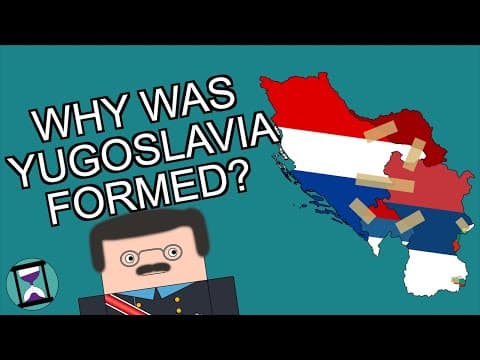
Yugoslavia was formed as a South Slavic state in the early 20th century, driven by nationalism and the desire for independence from Austro-Hungarian and Ottoman rule. This blog explores the historical context, key events, and the eventual unification of South Slavic peoples into Yugoslavia, highlighting the complexities and challenges faced during its formation.
Yugoslavia is often remembered for its tumultuous breakup, marked by economic strife, governmental failures, ethnic tensions, and civil war. However, understanding why Yugoslavia was formed in the first place requires a look back at the historical context and the aspirations of the South Slavic peoples.
The idea of a unified South Slavic state predates the formation of Yugoslavia by nearly a century, emerging in the late 19th century. At that time, Serbia was the only independent Slavic state in the region, and it looked to the unification of Italy as a model for its own aspirations. This desire for a strong and independent South Slavic nation resonated with many who lived under the Ottoman Empire to the south and the Austro-Hungarian Empire to the north.
The early 20th century was a period of significant upheaval for the Ottoman Empire, which faced a series of revolts. In response, the Balkan League was formed, leading to the expulsion of the Ottomans from the region. Serbia emerged victorious in these conflicts, capturing substantial territory. However, the great powers of Europe intervened, limiting Serbia's territorial gains, which led to tensions with Bulgaria and the onset of the Second Balkan War. Ultimately, Serbia's military successes expanded its influence and included many Macedonians, bolstering its credentials as a potential leader of a pan-Slavic state.
To the north, the Austro-Hungarian Empire was home to a diverse Slavic population, including Serbs, Croats, Slovenes, and Bosnians. These groups shared a common desire for independence from the imperial rule of Vienna and Budapest. However, the prospect of individual ethnicities breaking away was daunting, as Austria-Hungary was too powerful to be easily dismantled.
In light of these challenges, the concept of Yugoslavism gained traction. Many believed that uniting the South Slavic peoples under a single state could provide a viable path to freedom. Despite some skepticism regarding the potential effectiveness of a Yugoslav state, the urgency of the situation overshadowed these concerns. The assassination of Archduke Franz Ferdinand in 1914, which sparked World War I, further destabilized the region and set the stage for discussions about the future of the South Slavs.
In 1917, as the war raged on, Serbian leaders in exile convened with exiled academics from Austria-Hungary to discuss the post-war landscape. Serbia's initial goal was to annex all South Slavic territories, but the realities of war forced them to make concessions. The fear that Austria-Hungary might negotiate peace and retain control over its Slavic territories prompted the signing of the Corfu Declaration. This document asserted the South Slavic peoples' desire for unification and promised equal treatment for all ethnic groups within the new state.
As the Austro-Hungarian Empire crumbled, the South Slavic regions declared their independence. The newly formed state of Slovenes, Croats, and Serbs was initially intended as a temporary claim on territory before merging with Serbia. This merger was ultimately successful, with Italy receiving only a fraction of the territory, allowing the South Slavs to determine their own national identity.
It wasn't until the early 1930s that the new nation, now officially called Yugoslavia, began to establish its governance and identity. The complexities of uniting diverse ethnic groups under a single national framework would continue to challenge the country throughout its existence.
The formation of Yugoslavia was a significant historical event driven by the aspirations of the South Slavic peoples for unity and independence. While the initial vision of a harmonious multi-ethnic state was fraught with challenges, it laid the groundwork for a complex national identity that would evolve over the decades. Understanding this history is crucial to grasping the subsequent events that led to the eventual disintegration of Yugoslavia in the 1990s.



















