
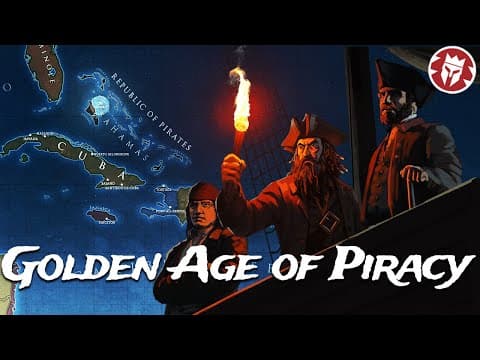
After the War of the Spanish Succession ended in 1713, many unemployed privateers turned to piracy, especially in the Caribbean. Pirates like Benjamin Hornigold, Blackbeard, and Sam Bellamy established bases in Nassau, disrupting trade and creating the notorious Republic of Pirates. Pirate life was harsh but democratic, and their impact forced the British government to take action.
By the summer of 1750, more than a year had passed since the conclusion of the War of the Spanish Succession. With the war over, European maritime powers sought to rebuild their overseas trade fleets and replenish their treasuries. However, the war's end had an unintended consequence: hundreds of unemployed sailors, who had served as privateers during the war, turned their skills to piracy. This marked the beginning of a rampant era of piracy, especially in hotspots like the West Indies and Madagascar.
This article explores the final and most well-known phase of the Golden Age of Piracy, focusing on the lives and tales of infamous pirates from the post-Spanish Succession period, roughly 1715 to 1726.
The War of the Spanish Succession (1701-1713) was a great power contest over the Spanish throne. In May 1702, Queen Anne of England authorized privateers to attack French and Spanish merchant shipping. Privateers were privately owned vessels commissioned by governments through letters of marque to attack enemy commerce. This was a cost-effective alternative to maintaining large war fleets.
British and American privateers were highly successful, capturing over 2,000 ships during the war. The 1713 Peace of Utrecht ended the war, establishing Great Britain as the dominant maritime power in Europe.
The war's end led to mass unemployment among sailors and privateers. The Royal Navy demobilized rapidly, cutting its manpower by nearly 75%, and privateering contracts became worthless. Many sailors struggled to find work on merchant ships, often earning meager wages.
Meanwhile, the Caribbean remained dangerous. Spanish Coast Guard vessels, known as the Guadas Costas, aggressively seized English vessels, accusing them of smuggling if any Spanish coins were found aboard. This led to significant losses for English merchants and harsh treatment of captured sailors, including imprisonment and torture.
Frustrated by Spanish aggression and British neglect, many sailors and ex-privateers turned to piracy. The war had inadvertently trained thousands of new pirate recruits.
One of the first to turn pirate was Benjamin Hornigold, who brought with him Edward Teach, later known as Blackbeard. Both had served as privateers during the war and were unemployed by 1713. They decided to attack Spanish ships and enrich themselves.
They chose the Bahamas, specifically New Providence Island and its capital Nassau, as their base. Nassau had been devastated during the war and was largely abandoned, making it an ideal pirate haven.
Hornigold and his crew organized into bands, attacking Spanish vessels and plantations from Florida to Cuba. Their raids brought in valuable loot, including silks, silver coins, and rum.
By 1715, over 2,000 ex-privateers had settled in Nassau, calling their anarchic community the Republic of Pirates.
Blackbeard became one of the most feared pirates, known for his cruelty and terrorizing the West Indies aboard his flagship, the Queen Anne's Revenge. He captured a French slave ship in 1717 and used it to enhance his raiding capabilities.
Vain specialized in attacking ships bound for North American ports. He often sailed in flotillas with other pirate captains, balancing aggression with caution to maintain his success.
Bellamy was one of the most successful pirates, believed to have plundered over $130 million in loot. Known as the "Robin Hood of the seas," he was well-mannered and democratic, with his crew electing officers and making decisions collectively. Bellamy captured several ships, including the slave ship Widar, which he made his flagship.
Known for his flamboyant style, Rackham gained fame alongside his partner Anne Bonnie, a young Irish woman who fought fiercely by his side. Rackham was initially quartermaster on Vain's ship before becoming a captain himself.
A gentleman pirate, Bonnet was a wealthy plantation owner who turned to piracy to escape his unhappy marriage. Despite his status, he lacked the skills of other pirates and eventually joined Blackbeard's crew.
Contrary to popular romanticized portrayals, pirate life was harsh, crowded, and dirty. Crews were large and diverse, including escaped slaves, disgraced sailors, ex-privateers, and men from various backgrounds.
Pirate society was surprisingly democratic. Crews signed articles that governed behavior, including keeping weapons ready, banning gambling, and restricting drinking to prevent fires. Captains and quartermasters were elected and could be deposed by the crew.
Pirates preferred to avoid combat when possible, using intimidation and bold displays to force surrender. If resistance occurred, they engaged in brutal boarding actions.
On July 24, 1715, a Spanish treasure fleet carrying jewels, gold, and silver worth around 14 million pesos was wrecked by a hurricane off Florida. The Spanish salvaged much of the treasure, but about 350,000 pieces of eight remained guarded onshore.
Several ex-privateers, including Jennings, Hornigold, Teach, Vain, and Bellamy, attacked the Spanish guards and seized the treasure, taking it to Jamaica. However, the Jamaican governor, under pressure from Spain, threatened punishment, forcing the pirates to retreat to Nassau.
By 1717, the pirates of Nassau had severely disrupted Caribbean trade, including British commerce. The British government under King George I took notice, and a consortium of merchants devised plans to restore order and suppress piracy.
The Golden Age of Piracy was born from the aftermath of war, economic hardship, and political neglect. Former privateers transformed into pirates, creating a unique and democratic society that challenged colonial powers and disrupted trade. Their legacy remains a fascinating chapter in maritime history, blending adventure, brutality, and rebellion on the high seas.
More stories about history's greatest rogues and adventurers continue to captivate audiences worldwide.



















