
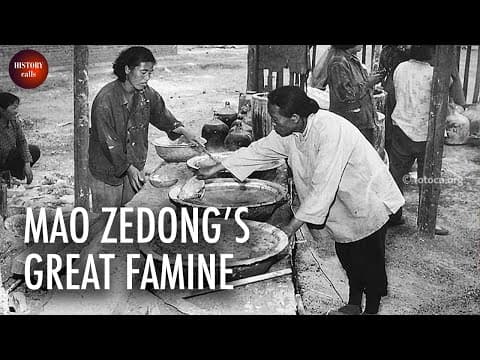
The Great Leap Forward, initiated by Mao Zedong, aimed to transform China into a socialist society through collective farming and communal living. However, the policies led to widespread famine, demotivation among peasants, and severe food shortages, resulting in millions of deaths. This blog post explores the structure of the communes, the failures of agricultural policies, and the human suffering that ensued during this tragic period in Chinese history.
The Great Leap Forward, a campaign initiated by Mao Zedong in the late 1950s, aimed to rapidly transform China into a socialist society through collective farming and communal living. However, this ambitious initiative resulted in one of the deadliest famines in history, known as the Great Chinese Famine. This blog post delves into the structure of the communes, the failures of agricultural policies, and the human suffering that ensued during this tragic period in Chinese history.
During a journey, Mao Zedong was inspired by a banner praising the first experimental people's commune in Henan province. He declared that the people's commune would be the bridge to a Socialist Paradise. This vision quickly spread across the country, leading to the formation of thousands of communes within a single summer. These communes were designed to consist of up to 2,000 families, with plans for even larger communes combining 10,000 to 20,000 households, all under the leadership of dedicated party cadres.
The communes represented a radical shift in lifestyle, abolishing private property and pooling resources. Houses, animals, land, and production tools became collective property. Nurseries and free compulsory schools were established to free women from traditional maternal duties, allowing them to work in the fields. The family unit was dismantled, and children were raised under the new collective rules, reducing individuals to mere cogs in a vast machine.
Life in the communes was regimented, with workdays starting at dawn and ending after dark, often accompanied by music celebrating the Great Leap Forward. The communal lifestyle aimed to immerse individuals in collective living, but it also stripped away personal freedoms. Men and women were separated into dormitories, and sexual relationships were heavily regulated. Many couples faced public humiliation for attempting to maintain their relationships, leading to tragic outcomes, including suicides.
The communes operated under a system where all meals were provided in collective canteens, and money was often abolished. Instead, a system of work points was established, where food distribution was based on each person's ability to meet production targets. This system led to severe consequences: if a person's name was not on the attendance list, they faced punishment and loss of food.
The lack of motivation among peasants resulted in low productivity. The authorities, often lacking agricultural knowledge, made decisions that disregarded local conditions, leading to poor harvests and the first signs of food shortages. Despite these challenges, Mao insisted on increasing agricultural production, encouraging communes to compete against each other for higher yields.
As the situation worsened, a culture of deception took hold. Cadres inflated production figures to meet party quotas, leading to widespread falsification of agricultural and industrial outputs. Reports of bountiful harvests were often fabricated, masking the reality of food shortages. The consequences of these exaggerations were dire, as the state demanded high taxes based on these false figures, leaving communes with little to sustain their populations.
By the spring of 1959, the situation had deteriorated significantly. The disastrous harvests forced communes to ship out crops to repay debts, particularly to the USSR for industrial aid. As food became increasingly scarce, families resorted to desperate measures, including eating tree bark and mud. The famine claimed countless lives, with reports of individuals collapsing from starvation.
The power dynamics within the communes were brutal. Cadres controlled food distribution, often allocating themselves more than the peasants. Those who fell out of favor with the leadership faced starvation, and the principle of "he who does not work shall not eat" led to the deliberate neglect of vulnerable populations, including pregnant women and the elderly.
The harsh conditions led to acts of violence and cruelty. Cadres wielded their power over the collective canteens, using food as a weapon against those who disobeyed them. Stories emerged of individuals being beaten to death for minor infractions, and tragic accounts of women exchanging their bodies for food highlight the desperation faced by many.
The Great Leap Forward, intended as a bold step towards a socialist utopia, instead resulted in one of the most devastating famines in history. The policies implemented during this period not only failed to achieve their goals but also led to immense human suffering and loss of life. Understanding this dark chapter in Chinese history is crucial for recognizing the consequences of extreme ideological pursuits and the importance of sound governance and agricultural practices.



















