
World War I, also known as the Great War, was a transformative conflict that reshaped nations and societies. Key causes included imperialism, militarism, nationalism, and a complex web of mutual defense treaties. The war's impact extended beyond the battlefield, influencing American society, women's roles, and global politics, ultimately leading to the Treaty of Versailles and setting the stage for future conflicts.
The early 20th century marked a period of profound upheaval and transformation across the world. The First World War, known as the Great War, ushered in a crisis that reshaped nations, economies, and societies on an unprecedented scale. This conflict brought about immense destruction, tested alliances, and fundamentally altered the course of history.
America's involvement in World War I was a pivotal moment, signaling a shift from isolationism to a more active role on the global stage. The war demanded significant sacrifices from the American people and challenged the nation's ideals, industries, and social fabric. The impact of the war was felt far beyond the battlefield, influencing domestic policies, economic structures, and the daily lives of ordinary Americans. The Great War not only defined an era but also set the stage for future conflicts and challenges of the 20th century. Understanding America's role in this global crisis helps us grasp the broader implications of war and its lasting effects on both the nation and the world.
Imperialism was a significant cause of World War I, as nations competed for global dominance, resources, and strategic territories. The Scramble for Africa and the spheres of influence in China exemplified this competition, where European powers sought to expand their empires and control valuable regions. Nations fought over raw materials such as rubber, oil, and precious metals, essential for fueling industrial economies. This competition not only provided economic benefits but also served as a symbol of national prestige, contributing to a rise in nationalism.
Mutual defense treaties were a key factor that contributed to the outbreak of World War I. These treaties created a web of alliances that ultimately led to a global conflict. Agreements between countries to support and defend one another if one was attacked had the unintended consequence of escalating conflicts rapidly. Key alliances included Russia and Serbia, Germany and Austria-Hungary, and Britain, France, and Belgium. When tensions escalated after the assassination of Archduke Franz Ferdinand, the alliance system triggered a chain reaction that pulled multiple nations into the conflict.
Militarism also played a significant role in causing World War I. Nations increasingly relied on military power to assert their dominance and protect their national interests. The early 20th century saw a massive arms race, with countries competing to develop advanced weaponry. This competition created an atmosphere of tension and distrust among the great powers of Europe. The presence of large, well-trained armies made war seem like an inevitable solution to political disputes, contributing to the outbreak of World War I.
Nationalism was another major driving force behind the outbreak of World War I. It created deep-rooted tensions and rivalries between nations. Nationalism, the belief in the superiority and interests of one's own nation, often at the expense of others, had been brewing for over a hundred years. One significant nationalist tension involved the Slavic people within the Austro-Hungarian Empire, particularly in Bosnia, who desired to break away and join Serbia. This desire for national unity directly challenged Austria-Hungary's authority and contributed to growing unrest in the region.
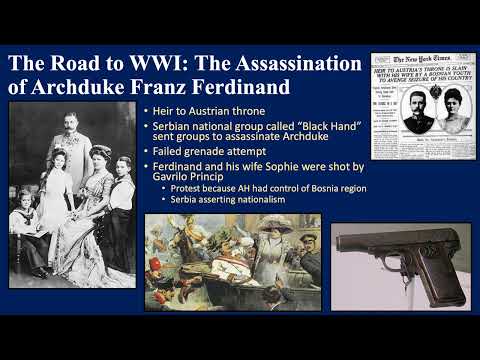
The assassination of Archduke Franz Ferdinand on June 28, 1914, was the immediate spark that set off World War I. Ferdinand and his wife were killed by Gavrilo Princip, a member of the Serbian nationalist group known as the Black Hand. This act was seen by Austria-Hungary as an attack on their authority, triggering a chain reaction of diplomatic responses and military mobilizations across Europe. Austria-Hungary declared war on Serbia, leading to Russia mobilizing in defense of Serbia, which prompted Germany to declare war on Russia, and so forth, drawing multiple nations into the conflict.
As the world edged closer to full-scale war, nations began to align themselves into two major alliances. On one side was the Triple Entente, also known as the Allied Powers, which included France, Great Britain, and Russia. Over time, they received support from countries such as the United States and Japan. On the other side was the Triple Alliance, referred to as the Central Powers, which included Austria-Hungary, Germany, and initially Italy, which later switched sides.
Initially, President Wilson adopted a policy of neutrality, aiming to keep the United States out of the conflict. However, tensions escalated with incidents such as the sinking of the Lusitania in 1915 and the interception of the Zimmerman Telegram in 1917, which urged Mexico to join the war against the United States. These provocations led to President Wilson formally requesting Congress to declare war on April 2, 1917, marking America's transition from neutrality to active involvement in the global conflict.
During World War I, children and education were significantly impacted as the nation shifted its focus to the war effort. Increased responsibilities fell upon children, who took on additional household and farm duties while older children often worked in factories. Schools adapted to the war by implementing a war-inspired curriculum, incorporating patriotic themes into lessons and encouraging children to contribute to food production efforts.
The war also transformed the lives of women in America. With many men away at war, women stepped into jobs traditionally held by men, including factory work and public service positions. Their contributions to the war effort strengthened the push for women's suffrage, ultimately leading to the passage of the 19th Amendment in 1920, granting women the right to vote.
Over 4 million American men were mobilized to serve, with approximately 116,000 deaths and over 200,000 wounded. The demographic of these soldiers reflected the diverse population of the United States, including native-born Americans, immigrants, and African Americans, who served primarily in segregated units. The psychological toll of the war was immense, with many soldiers suffering from what was then called shell shock, now recognized as PTSD.
Life at home during World War I was marked by significant changes and challenges. Rationing and conservation became national efforts, with citizens encouraged to conserve food and materials to support the war effort. The government promoted liberty bonds to finance the war, fostering a sense of unity and shared responsibility among Americans.
Adding to the hardships of wartime life was the Spanish Flu pandemic of 1918, which spread rapidly and killed an estimated 50 to 100 million people worldwide. The flu outbreak placed immense strain on healthcare systems already overwhelmed by the war, leading to quarantine measures and social distancing protocols.
On November 11, 1918, Germany signed an armistice, bringing an end to the fighting. The Treaty of Versailles was signed in 1919, officially codifying peace between Germany and the victorious Allied Powers. The treaty imposed harsh reparations on Germany and limited its military capabilities, creating resentment and economic hardship that contributed to the rise of extreme nationalism in the country.
One of the key outcomes of the Treaty of Versailles was the creation of the League of Nations, established in 1920 to maintain world peace and prevent future conflicts. While the treaty ended World War I, its punitive measures against Germany sowed the seeds of future conflict, contributing to tensions that would eventually lead to World War II.
World War I was a transformative conflict that reshaped nations and societies. Its causes were complex, rooted in imperialism, militarism, nationalism, and a web of alliances. The war's impact extended beyond the battlefield, influencing American society, women's roles, and global politics, ultimately leading to the Treaty of Versailles and setting the stage for future conflicts.



















