
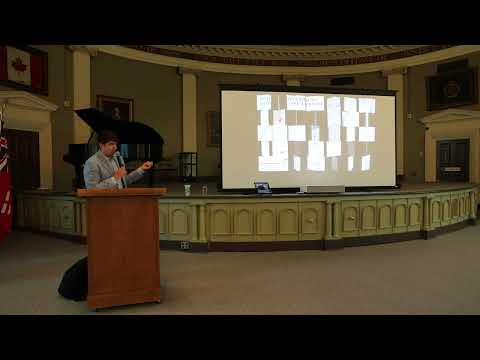
Dr. Scott Berthelette's presentation explores the history of the Haudenosaunee captives taken by the French in the late 17th century, detailing their experiences in captivity, the strategies employed by their leaders for their return, and the broader implications of these events on Euro-Indigenous relations.
The Department of Heritage Services with the City of Kingston hosted a Heritage Hour featuring Dr. Scott Berthelette, a professor in the Department of History at Queen's University. Dr. Berthelette's research focuses on the history of New France, Indigenous peoples, the fur trade, and Euro-Indigenous relations in North America. This blog post summarizes his presentation on the Haudenosaunee captives taken by the French in the late 17th century.
Dr. Berthelette began with a land acknowledgment, recognizing that Kingston is situated on the traditional homeland of the Anishinaabe, Haudenosaunee, and Huron-Wendat nations. He expressed gratitude for their stewardship of the land.
In June 1687, Jacques-René de Brisay, governor general of New France, prepared for war against the Haudenosaunee Confederacy, known to the French as the Iroquois. His forces gathered at Cataraqui, the site of Fort Frontenac, which had been established in 1673. The invasion aimed to strike a decisive blow against the Seneca, the westernmost nation of the Confederacy.
Before the invasion commenced, Denonville's forces captured hundreds of Haudenosaunee individuals, including a peaceful delegation from Onondaga, who were misled into believing they were attending a feast. Among the captives, 36 men were sent to serve as galley slaves in France, following orders from King Louis XIV to capture as many Haudenosaunee as possible.
The Haudenosaunee captives were transported down the Saint Lawrence River to Quebec and then shipped to France, where they endured harsh conditions. Dr. Berthelette's research centers on the experiences of these captives, some of whom eventually returned to North America.
Prior to European contact, the Haudenosaunee Confederacy was formed by five nations: Mohawk, Oneida, Onondaga, Cayuga, and Seneca. Their traditional territory spanned Upper New York State. The term "Haudenosaunee" translates to "people of the longhouse," reflecting their communal living structures and governance.
Upon their arrival in France in October 1687, the Haudenosaunee captives were sent to Marseilles. Dr. Berthelette introduced key figures in the French administration, including Jean-Baptiste Colbert, the Marquis de Seignelay, and Michel Bégon, who oversaw the treatment of the captives.
The French galley fleet, which included both convicts and enslaved individuals, was notorious for its brutal conditions. Captives were often chained and forced to march long distances under severe mistreatment. The Haudenosaunee captives were initially treated with some leniency, receiving better rations than typical galley slaves, likely due to their status as Indigenous individuals.
The French were particularly interested in converting the captives to Catholicism, viewing their spiritual salvation as a propaganda victory. Some Haudenosaunee captives had prior exposure to Christianity through Jesuit missionaries, which may have influenced their treatment in France.
Dr. Berthelette outlined the strategies employed by Haudenosaunee leaders to secure the return of their relatives. These included military coercion, diplomatic negotiations, and appeals to the English government.
In retaliation for the French invasion, the Haudenosaunee launched attacks against French settlements, capturing French soldiers and settlers as bargaining chips for the return of their people.
In June 1688, a treaty of neutrality was signed in Montreal, allowing Haudenosaunee leaders to negotiate for the return of their captives. They successfully secured the release of 91 individuals held at the La Montagne mission, while the fate of the 36 galley slaves remained uncertain.
Haudenosaunee leaders also sought assistance from the English governor of New York, Thomas Dongan, to advocate for their captives. This diplomatic approach highlighted the Confederacy's desire for autonomy and recognition as allies rather than subjects.
In 1689, following increased military pressure and diplomatic negotiations, plans were made to return the Haudenosaunee captives to North America. However, only 13 of the original 36 captives survived the ordeal and returned home.
Dr. Berthelette's presentation sheds light on a dark chapter in the history of the Haudenosaunee people, marked by suffering and resilience. The French invasion and subsequent captivity of the Haudenosaunee individuals illustrate the complexities of Euro-Indigenous relations during this period. Despite the tragic circumstances, the leadership of the Haudenosaunee Confederacy employed various strategies to pressure the French for the return of their relatives, demonstrating their agency and resilience in the face of adversity. The eventual return of the captives was a testament to the strength of their community and the effectiveness of their diplomatic and military efforts.



















