
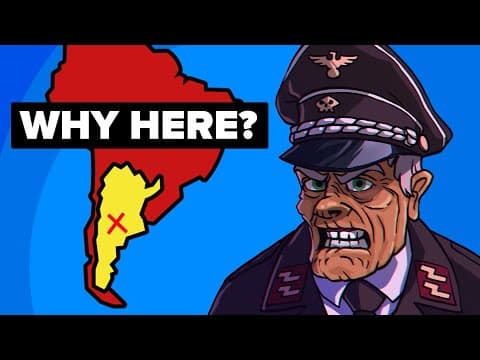
After World War II, many high-ranking Nazi officials fled to Argentina and other South American countries to escape justice. This blog post explores the reasons behind their escape, the networks that facilitated their flight, and the subsequent efforts to capture them, revealing a complex web of post-war intrigue and the moral dilemmas faced by intelligence agencies.
Did you or your parents grow up with a Nazi war criminal living on your street? After World War II, many high-ranking Nazi officials fled to Argentina and other South American countries to escape justice. This blog post explores the reasons behind their escape, the networks that facilitated their flight, and the subsequent efforts to capture them, revealing a complex web of post-war intrigue and the moral dilemmas faced by intelligence agencies.
At the end of April 1945, as the Red Army marched into Berlin, Adolf Hitler's regime was crumbling. Hitler had ordered his own cremation to prevent his body from being captured by the Soviets. Despite the chaos, some high-ranking Nazis believed they could escape. Hitler's private pilot, Hans Baur, urged him to flee, suggesting various destinations, including Argentina. However, Hitler refused, preferring death over a life on the run.
As the war ended, many Nazis sought refuge in South America. The reasons for this choice included:
The escape routes, known as ratlines, were facilitated by various individuals, including members of the Catholic Church, who helped Nazis obtain false identities and travel documents.
As the Allies sought to capture Nazi war criminals, a secret war of intelligence began. The United States, the United Kingdom, and the Soviet Union were all eager to find and interrogate these individuals for their knowledge of Nazi secrets, including advanced weaponry and intelligence operations.
The CIA and other intelligence agencies were aware of the presence of Nazis in South America. Some agencies even employed former Nazis as spies during the Cold War, believing their knowledge could be useful against the Soviet Union. This led to a moral quandary: should they protect war criminals for the sake of political expediency?
One of the most notorious Nazis to escape was Adolf Eichmann, a key architect of the Holocaust. After the war, he lived under a false identity in Argentina, working at a Mercedes-Benz plant. In 1960, Israeli Mossad agents captured him and brought him to trial in Israel, where he was executed in 1962.
Another infamous figure was Josef Mengele, known as the "Angel of Death" for his inhumane experiments on concentration camp prisoners. Mengele evaded capture for decades, living in South America until his death in 1979.
The ratlines allowed many Nazis to escape justice, leading to a complex legacy of post-war morality. While some were captured and tried, many others lived out their lives in relative peace, raising questions about the effectiveness of post-war justice and the moral compromises made by intelligence agencies.
The flight of Nazi officers to Argentina and other countries after World War II highlights the dark complexities of post-war justice and the lengths to which individuals and governments will go to protect their interests. The stories of those who escaped and those who sought to bring them to justice continue to resonate today, reminding us of the importance of accountability and the dangers of turning a blind eye to past atrocities.



















