
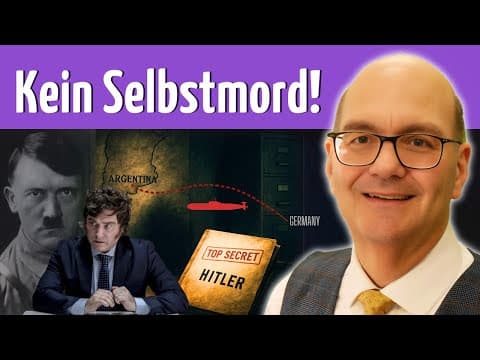
This blog post explores the controversial theory that Adolf Hitler survived World War II and fled to South America, supported by declassified FBI documents and eyewitness accounts. It discusses the implications of this theory on historical narratives and the motivations behind the concealment of such information.
The narrative surrounding Adolf Hitler's death has long been accepted as fact: he died by suicide in his bunker in Berlin in 1945. However, recent discussions and declassified documents suggest a different possibility—that Hitler may have escaped to South America. This blog post delves into the evidence supporting this theory, the motivations behind the official narrative, and the implications for our understanding of history.
The widely accepted account states that Hitler and Eva Braun took their lives in the Führerbunker as the Allies closed in on Berlin. Their bodies were subsequently burned, marking the end of Hitler's life. However, skepticism about this narrative has persisted since the end of the war. Notably, Joseph Stalin reportedly doubted the veracity of Hitler's suicide, suggesting that he might have escaped.
The turning point in this discussion came with the release of documents under the Freedom of Information Act, initiated by President Bill Clinton. These documents, available from the CIA and FBI, include reports from agents who claimed to have seen Hitler in South America after the war. These accounts are not isolated; they form a series of reports that detail sightings and movements of Hitler in various locations across the continent.
One notable figure in this investigation is Jan von Helsing, who authored a book on the subject and traveled to South America to trace Hitler's alleged path. His findings, along with those from a U.S. television documentary series, suggest that there is substantial evidence supporting the theory that Hitler survived and fled.
A documentary team, equipped with modern technology, retraced the steps outlined in the FBI documents. They discovered a tunnel connecting the Führerbunker to a larger subway system, which could have facilitated Hitler's escape. This tunnel, now sealed, indicates that there were indeed plans for an escape route.
The documentary also explored various locations in South America where Hitler was reportedly sighted. Eyewitnesses claimed to have seen him in a theater known for Wagner operas, a favorite of Hitler's, and in the vicinity of a mansion owned by a family sympathetic to the Nazi regime. Ground-penetrating radar was used to uncover tunnels linking these locations, lending credibility to the claims.
If Hitler did escape, it raises significant questions about the motivations behind the official narrative of his death. Why was it so crucial to propagate the story of his suicide? Some theorists suggest that allowing Hitler to live could have revealed uncomfortable truths about the war and the involvement of various parties, including American financiers who supported the Nazi regime.
The theory posits that Hitler's rise was not merely a product of German nationalism but was influenced by external forces. Financial support from wealthy Americans, including figures like Henry Ford and Prescott Bush, played a role in the Nazi party's ascendance. This raises questions about the extent to which Hitler was a puppet of larger geopolitical agendas.
The discussion around Hitler's potential escape also draws parallels with contemporary political narratives. Just as many people turned a blind eye to the atrocities committed during the Nazi regime, there are concerns today about how history is presented and the narratives that are accepted without question.
The idea that Hitler could have lived on in South America challenges the simplistic view of good versus evil in World War II and suggests a more complex interplay of power, ideology, and survival.
The theory that Adolf Hitler escaped to South America is supported by a growing body of evidence, including declassified documents and eyewitness accounts. While the official narrative of his death remains dominant, the implications of this alternative history are profound, prompting us to reconsider the complexities of historical narratives and the motivations behind them. As new information continues to emerge, the quest for truth about one of history's most infamous figures remains ongoing.



















