
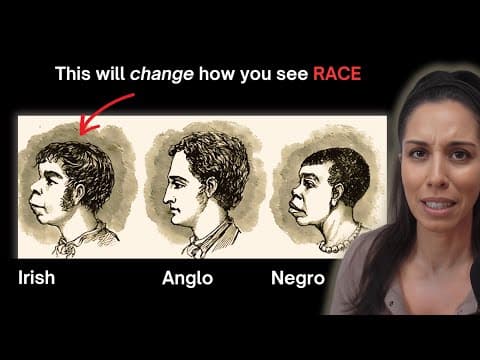
This blog post explores the historical perception of the Irish as racially inferior in the 19th century, detailing the pseudoscientific practices that classified them as less than fully white, the societal implications of these beliefs, and how Irish immigrants navigated their identity in America.
Imagine a scientist scrutinizing your features and assigning you a score that determines your worthiness as a human being. In 1885, British anthropologist John Bedau did just that by creating the Index of Negrin, a scale that ranked individuals based on their perceived racial characteristics. For the Irish, this meant being classified as less than fully white, a notion that had profound implications for their identity and treatment in society.
In the 19th century, race was not merely about skin color; it was intricately tied to power dynamics and societal hierarchies. Scientific racism, the misuse of science to justify racial superiority, was prevalent and widely accepted. This pseudoscience was not a fringe belief but rather a mainstream ideology that permeated newspapers, universities, and public policy.
One of the most notorious forms of this pseudoscience was phenology, which posited that skull shape could determine intelligence and moral character. Scientists measured various facial features to argue that certain groups were inherently superior or inferior. For the Irish, the findings were damning. Bedau's research, which involved ranking 13,000 men based on hair color, concluded that the Irish, along with the Welsh and Scots, were significantly darker than Anglo-Saxons. This led to the assertion that the Irish were a separate, lower race, characterized as more primitive and less capable of self-governance.
The implications of these scientific theories were far-reaching. They justified discrimination and shaped public perception of the Irish in both Britain and America. Notable figures, such as historian Charles Kingsley, expressed their disdain for the Irish, referring to them as "human chimpanzees." Such views were not isolated; British political cartoons often depicted the Irish with exaggerated, ape-like features, reinforcing the stereotype of the Irish as violent and inferior.
When Irish immigrants arrived in the United States, they faced significant hostility. They were often met with signs stating "No Irish Need Apply" in job postings, reflecting the widespread belief that they were unworthy of employment. Political cartoons in America echoed the British sentiment, portraying the Irish as dangerous and unfit for citizenship. One cartoon depicted Lady Liberty stirring a pot of immigrants, with an Irish man standing out as unruly and disruptive, symbolizing the perception that the Irish could not assimilate into American society.
Despite the challenges, many Irish immigrants sought to distance themselves from other marginalized groups, particularly Black Americans, to secure their place in society. They began to align politically with white Anglo-Saxons and Protestants, adopting their customs and language. Over time, Irish Americans became integral to the fabric of American society, particularly in cities like Boston and New York, where they took on roles as police officers and firefighters.
Understanding this history is crucial because it illustrates that race is not a fixed category but a tool used to divide and control. The Irish were once viewed as racially different and unworthy of being considered American. Their journey from the margins to a more accepted status highlights the fluidity of racial identity and the societal structures that influence it.
Most Irish Americans today are unaware of the prejudices their ancestors faced. The historical portrayal of the Irish as subhuman parallels the treatment of other marginalized groups, emphasizing the need to recognize and confront these patterns. History shapes our present, and acknowledging the past is essential to understanding our current societal dynamics.
Let us reflect on this history and its implications for our understanding of race and identity today. If you have Irish heritage or insights into this topic, your thoughts are welcome as we continue to explore the Irish American experience.



















