
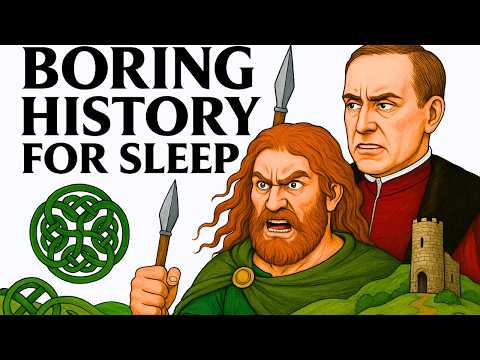
This comprehensive history of Ireland traces its journey from ancient Celtic kingdoms through Viking invasions, Norman conquest, English rule, and the complex socio-political struggles that shaped Irish identity. It highlights key figures like Brian Boru, the impact of Viking and Norman settlements, the Tudor conquest, religious conflicts, and the resilience of Irish culture amid centuries of upheaval.
For over a thousand years, the Irish fought for independence against wave after wave of invaders trying to claim their beautiful island. From Viking raiders with blood-soaked axes to English knights in gleaming armor, everyone wanted Ireland for themselves. Through it all, the Irish people somehow survived, living in the shadow of foreign powers while keeping their culture alive. Here's what life was really like in ancient and medieval Ireland.
Imagine waking up in a tiny one-room house inside a ring fort, surrounded by earth walls and wooden palisades. About 20 families live together for protection against raiders. The morning air is filled with smoke from the dying embers of the cooking fire. Life is harsh; you sleep on scratchy wool blankets over rushes on a dirt floor, sharing the space with your entire family.
Around 500 CE, Ireland was divided into about 150 tiny kingdoms called Tuatha, each ruled by a king (re). Some kings controlled several Tuatha, becoming kings of tribes (rebiden), and the most powerful ruled entire provinces as kings over kings (riruire). At the top was the High King (Arri), a symbolic title with little real power.
The ancient capital was at Tara, a sacred hill. The Irish had so many kings that it was said if you threw a rock in any direction, you'd probably hit one.
Breakfast was simple porridge made from oats, sometimes with milk. Water was drawn from nearby streams, often unsafe. Most people were farmers, tending cattle, growing oats and barley. Cattle were the main form of wealth, used for milk, occasional meat, fines, and taxes.
Political fragmentation was Ireland's biggest weakness. The tiny kingdoms constantly fought each other over cattle, land, or personal disputes. Alliances formed and broke rapidly, preventing unity against external threats.
Druids were highly educated religious leaders, legal authorities, and keepers of knowledge, trained for about 20 years. They held significant power, including the ability to declare someone an outcast.
Unlike Britain, Ireland was never invaded by the Romans, though there was some trade contact. Around the 5th century, Christianity arrived, famously associated with St. Patrick, a Romano-British man who was kidnapped by Irish raiders, escaped, became a priest, and returned to convert the Irish.
Irish Christianity absorbed many pagan traditions, with Celtic gods becoming saints and festivals turning into Christian holy days. The Celtic cross combines Christian and sun symbols.
In 795, Viking raids began with an attack on a monastery on Lambay Island. Vikings targeted monasteries for their wealth and slaves. Their longships were fast and could navigate rivers, allowing deep inland raids.
The Vikings established permanent settlements, notably Dublin in 840, which became a fortified trading post and military base. Irish kings sometimes allied with Vikings against rivals, complicating resistance.
King Mael Sechnaill famously used Viking advice to destroy their camps, leading to the capture and execution of Viking leader Teresius. However, political fragmentation continued to hinder unified resistance.
Viking leaders like Olaf the White and Ivar the Boneless ruled Dublin, with Vikings gradually assimilating into Irish culture, creating a hybrid Norse-Gaelic identity.
Brian Boru, from a minor clan in County Clare, rose to power by uniting much of Ireland and fighting the Vikings. He defeated the Vikings at the Battle of Sulcoit in 968 and later became High King of Ireland in 1002.
In 1014, the Battle of Clontarf marked a decisive confrontation where Brian's forces defeated the Vikings and their allies. Brian was killed during the battle, but his victory ended Viking military dominance, transforming them into traders and settlers.
In 1169, Dermot MacMurrough, King of Leinster, invited Norman mercenaries to help regain his kingdom, leading to the Norman invasion of Ireland. Led by Richard de Clare (Strongbow), the Normans captured key cities and established control.
King Henry II of England arrived in 1171, asserting authority over Ireland and establishing the English crown's overlordship. The Normans built stone castles and reorganized towns, introducing feudal law.
The Black Death in 1348 devastated the English population in Ireland more than the Irish, leading to a contraction of English control to the Pale around Dublin. This allowed a Gaelic Revival where Irish language, laws, and customs resurged.
However, English statutes like the Statutes of Kilkenny attempted to prevent English settlers from adopting Irish ways, largely unsuccessfully.
Henry VIII declared himself King of Ireland in 1541, aiming for direct control. He implemented the surrender and regrant policy, transforming Irish chieftains into English-style landlords.
The Fitzgerald rebellion in 1534, led by Silken Thomas, was crushed, leading to increased English authority.
The Reformation added religious conflict, with most Irish remaining Catholic while English rulers imposed Protestantism. Elizabeth I's reign saw plantations and military campaigns to subdue Irish resistance.
Hugh O'Neill, Earl of Tyrone, led a major rebellion against English rule, culminating in the Battle of the Yellow Ford (1598) and the Battle of Kinsale (1601). Despite early successes, the rebellion failed.
In 1607, the Flight of the Earls marked the exile of Gaelic aristocracy, leading to the Plantation of Ulster, settling English and Scottish Protestants and sowing seeds of future sectarian conflict.
The 1641 Rebellion was a Catholic uprising against Protestant settlers, leading to widespread violence and the formation of the Confederate Ireland government.
Oliver Cromwell's campaign (1649-1650) was brutal, with massacres and land confiscations that devastated the Irish Catholic population and reshaped land ownership.
The Williamite War (1689-1691) between Catholic King James II and Protestant William of Orange ended with William's victory at the Battle of the Boyne.
Penal Laws severely restricted Catholic rights, land ownership, and religious freedom, marginalizing the native Irish.
Despite centuries of conquest and oppression, Irish culture, language, and identity persisted. The 18th century saw the rise of new forms of resistance, including intellectual movements and revolutionary republicanism inspired by the American and French revolutions.
The struggle evolved from religious and land issues to a broader national identity and political rights movement, laying the foundation for modern Irish nationalism.
This history reveals Ireland's resilience through invasions, internal divisions, cultural transformations, and the enduring spirit of its people. From ancient Celtic kingdoms to English rule, the Irish story is one of survival, adaptation, and the quest for sovereignty.



















