
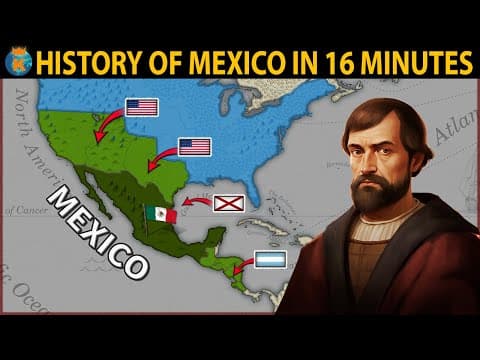
This blog post provides a concise overview of Mexico's history, detailing the Spanish conquest of the Aztec Empire, the subsequent colonization, the rise of independence movements, and the establishment of a republic, highlighting key figures and events that shaped the nation.
The history of Mexico is marked by significant events, including colonization, wars for independence, and the establishment of a republic. This post explores the key moments that shaped Mexico from the arrival of the Spaniards to its independence.
In 1519, Hernán Cortés set sail for Mexico with the goal of colonization. Initially authorized by Governor Diego Velázquez, Cortés proceeded despite the withdrawal of support. He arrived in Tabasco with 11 ships, 500 men, and 13 horses. Cortés was invited to Tenochtitlán by the Aztec Emperor Montezuma II, who mistakenly believed Cortés was the returning serpent god, Quetzalcoatl.
Cortés took advantage of this invitation, capturing Montezuma and leading a raid on the capital. However, news of another Spanish expedition led by Pánfilo Narváez, sent to arrest Cortés, forced him to leave Tenochtitlán temporarily. During his absence, Pedro de Alvarado massacred Aztec chiefs, igniting a fierce rebellion.
Upon returning, Cortés faced a strong Aztec resistance, resulting in the loss of many of his men during what is now known as the Night of Sorrows. The Spaniards retreated to Tlaxcala to regroup, while the Aztecs, under their new emperor Cuitláhuac, prepared for a final confrontation.
On July 7, 1520, Cortés and his remaining troops faced the Aztecs at the Valley of Otumba. Despite being outnumbered, the Spaniards turned the tide by targeting Aztec commanders, leading to a surprising victory. However, Cortés was severely wounded, and his forces were diminished.
By mid-August 1521, Cortés successfully retook Tenochtitlán, marking the end of the Aztec Empire. The Spaniards began colonizing the region, naming it Nueva España (New Spain). By 1547, they had dominated much of the former Aztec territory, leading to the deaths of millions of indigenous people due to diseases brought by the conquistadors.
The Spanish also initiated the conversion of indigenous people to Catholicism, with missionaries arriving as early as 1523. The Catholic Church's influence grew over the centuries, leading to tensions with the Spanish crown, particularly concerning the Jesuits.
The first signs of weakness in Spanish control emerged in 1808 with Napoleon's invasion of Spain. The Peninsular War distracted Spain from its colonies, allowing revolutionary sentiments to grow in New Spain.
On September 16, 1810, Father Miguel Hidalgo y Costilla issued the Grito de Dolores, calling for rebellion against Spanish rule. This marked the beginning of the Mexican War of Independence, attracting thousands of indigenous men and mestizos to the cause.
Despite initial setbacks, including Hidalgo's execution, the fight for independence continued under leaders like José María Morelos y Pavón and Agustín Iturbide. In 1821, the Treaty of Córdoba was signed, recognizing Mexican independence and establishing a constitutional monarchy.
Agustín de Iturbide became the first emperor of Mexico, but his reign was short-lived. He was overthrown by Antonio López de Santa Anna and Guadalupe Victoria, who established a federal republic. Santa Anna became known for his role in the Texas War of Independence.
The Mexican-American War resulted in significant territorial losses for Mexico, including Texas and California. Santa Anna's political career was tumultuous, leading to multiple exiles.
In the late 19th century, Porfirio Díaz's dictatorship led to widespread discontent, culminating in the Mexican Revolution of 1910, which resulted in approximately 2 million deaths.
The presidency of Lázaro Cárdenas beginning in 1934 brought stability and development to Mexico. Today, Mexico stands as a fully independent nation and a founding member of the United Nations, continuing to navigate its challenges and opportunities in the modern world.



















