
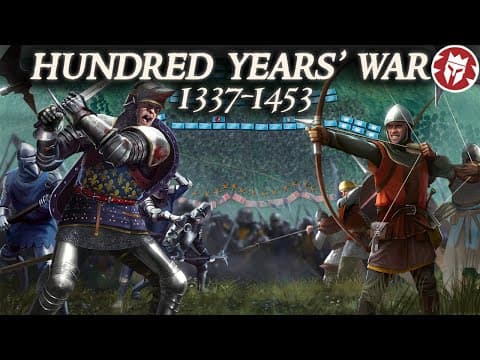
The Hundred Years' War was a pivotal conflict between England and France, spanning from 1337 to 1453. It is divided into three phases: the Edwardian phase, marked by English victories and the rise of the longbow; the Carolinian phase, characterized by a balance of power and the emergence of key figures like Joan of Arc; and the Lancastrian phase, which saw the decline of English power in France. The war reshaped both nations, leading to significant political and social changes, and ultimately resulted in the end of English territorial claims in France, except for Calais.
Welcome back, history enthusiasts, to another exciting journey through the annals of time! Today, we delve into the epic and tumultuous saga known as the Hundred Years' War. This century-spanning conflict between the kingdoms of England and France was a clash filled with daring knights, cunning tactics, and epic battles that would shape the course of European history.
The Hundred Years' War can be divided into three distinct phases, each with its own unique character:
The first phase, called Edwardian, featured the battles of Crécy and Poitiers, which saw the English longbowmen rise to prominence, wreaking havoc on the French forces with their deadly arrows as the legends of Edward III and the Black Prince emerged. The conflict began on two fronts almost immediately as the French began raiding an under-garrisoned Gascony. Edward III, facing financial difficulties, launched campaigns into France, leading to the infamous chevauchée raids that devastated French territories.
The second phase, known as the Carolinian phase, began with a balance between the two sides and soon spilled into Spain and beyond. This phase saw the emergence of key figures such as Bertrand du Guesclin and Joan of Arc, who played pivotal roles in the French resurgence.
The third phase, the Lancastrian phase, began with a devastating English victory at Agincourt by King Henry V. This phase was marked by a civil war within France between the Burgundians and the Armagnacs, but the country was ultimately saved by the famous heroine Joan of Arc, who turned the tide at Orléans.
The roots of the Hundred Years' War can be traced back to the complex feudal relationships and territorial disputes between England and France. The English monarchs held lands in France as vassals, leading to tensions that escalated into open conflict. The death of Charles IV of France without a male heir in 1328 created a dynastic crisis, further exacerbating tensions between the two kingdoms.
The Hundred Years' War was not just a series of battles; it was a transformative period that reshaped both England and France. The war led to significant political and social changes, including the rise of national identities and the decline of feudalism. By the end of the conflict, England had lost most of its territories in France, marking a shift in power dynamics in Europe.
The legacy of the Hundred Years' War continues to be felt today, as it laid the groundwork for the modern nation-states of England and France, and its stories of heroism and tragedy remain a captivating chapter in the history of warfare.



















