
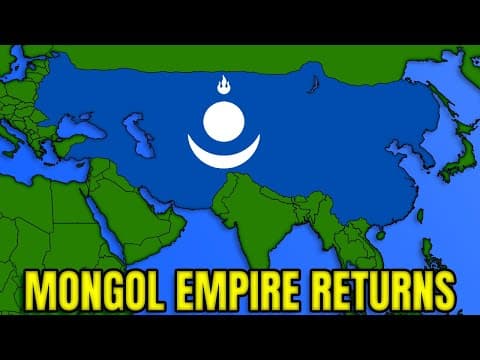
This blog post explores a fictional scenario where the Mongol Empire re-emerges in the modern world, examining its potential territorial expansions, military strategies, and geopolitical implications, including conflicts with various nations and empires.
In this exploration of a fascinating scenario, we delve into what might happen if the Mongol Empire, the largest empire in history, were to return in the modern day. Spanning from South Korea to Finland at its peak, the Mongol Empire's vastness and military prowess were unmatched. This post will outline the potential implications of such a resurgence, including territorial expansions and conflicts with contemporary nations.
The Mongol Empire reached its zenith around 1279, after which it fragmented into various states. For the purpose of this scenario, we will assume that the empire has returned in a stable form, with modern technology at its disposal, albeit perhaps not as advanced as today's standards. Additionally, we will consider a world where major international organizations like NATO, the EU, and the UN have been rendered ineffective.
Upon re-emergence, the Mongol Empire would likely begin its expansion by targeting regions that were historically part of its domain. With a focus on the Middle East for its oil resources, the Mongols would swiftly move to conquer countries like Kuwait, Syria, and Lebanon, eventually reaching Israel. In this scenario, Israel's attempts to defend itself with nuclear weapons would fail, leading to a rapid collapse of resistance in the region.
The aggressive expansion of the Mongol Empire would trigger a unification among Arab nations, reminiscent of the Islamic Empire's historical alliances. While some countries like Morocco and Mauritania might choose to remain neutral, the majority would band together to resist Mongol advances, creating a formidable opposition.
In a surprising twist, the Mongols would challenge India, a nation known for its military strength. However, in this scenario, India would be caught off guard and ultimately defeated, leading to significant geopolitical shifts in South Asia. The fall of India would send shockwaves around the world, raising alarms about the Mongol threat.
Following their success in India, the Mongols would turn their attention to Southeast Asia, where countries like Myanmar and Thailand would fall quickly. However, they would face challenges in Vietnam, where the dense jungles would hinder their military operations. Despite these setbacks, the Mongols would continue to consolidate their power across Asia.
As the Mongol Empire's influence spreads, Europe would find itself in a precarious position. Southern European nations might attempt to unite in a defensive alliance, reminiscent of the Roman Empire. However, the Mongols would advance rapidly, leading to a chaotic situation where various empires, including a revived Roman Empire and a Germanic faction, would emerge in response to the Mongol threat.
The Mongols would engage in fierce battles against these newly formed alliances. The Germanic tribes, emboldened by their historical legacy, would attempt to resist Mongol advances but would ultimately struggle against the overwhelming force of the Mongol military. The capture of key cities like Berlin and Paris would signify the Mongols' dominance in Europe.
With the Mongol Empire at its peak, the geopolitical landscape would be drastically altered. The empire would possess a significant arsenal of nuclear weapons, having acquired them from nations like China, North Korea, and Pakistan. This nuclear capability would pose a grave threat to any remaining powers that oppose them.
Despite their might, the Mongols would face logistical challenges in expanding beyond Europe and Asia. The inability to effectively navigate maritime routes would limit their reach to the Americas and other distant territories. This geographical constraint would ultimately shape the empire's future.
In this hypothetical scenario, the resurgence of the Mongol Empire would lead to a dramatic reshaping of the world order. With their military prowess and strategic advantages, the Mongols would pose a significant threat to global stability. However, their limitations in maritime expansion and the potential for resistance from unified nations would create a complex and dynamic geopolitical landscape. This thought experiment serves as a reminder of the intricate interplay between history, geography, and power in shaping our world today.



















