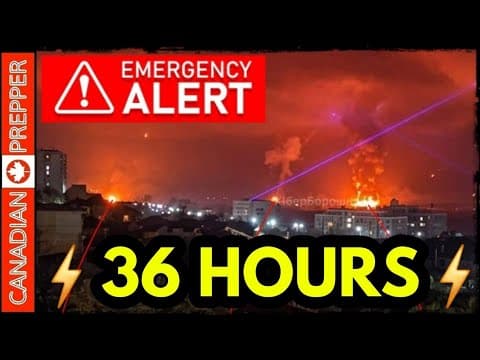
This article analyzes the escalating global conflict involving the US, Iran, Russia, and the Middle East, focusing on recent military operations, attacks on oil and gas infrastructure, and the potential for a catastrophic humanitarian crisis. It explores the implications of a possible power grid attack on Iran, the strategic significance of oil port shutdowns, and the broader geopolitical risks including nuclear escalation and global economic collapse.
As the world watches with growing concern, recent developments in global military and energy conflicts suggest we may be on the brink of a historic disaster. This article provides a comprehensive update on the escalating tensions involving the United States, Iran, Russia, and the broader Middle East region. It examines the recent military operations, the strategic targeting of oil and gas infrastructure, and the potential humanitarian and geopolitical consequences.
A recent high-cost operation involving the exfiltration of a pilot from hostile territory has drawn significant attention. The mission reportedly cost around one billion dollars and involved multiple aircraft losses. While many celebrate this as a tactical victory, it raises questions about the broader strategic objectives. There are indications that the operation may have had a dual purpose, possibly probing for nuclear material or intelligence rather than solely rescuing the pilot.
Iran's vast and rugged geography, including mountainous regions comparable to the Rocky Mountains, presents significant challenges for military operations. The difficulty of maintaining a presence deep within Iranian territory is considerable, with logistical and environmental obstacles complicating any prolonged engagement.
The scale and frequency of attacks on Russian oil and gas infrastructure, particularly port facilities, have been unprecedented. With approximately four million barrels of Russia's daily oil exports dependent on sea routes, continued disruption could provoke serious escalatory responses from Vladimir Putin's government. Simultaneously, tensions with Iran are intensifying, with threats of attacks on critical infrastructure and the possibility of a broader regional conflict.
Over the past 72 hours, numerous oil refineries, ports, and petrochemical complexes across Russia, Iran, the United Arab Emirates, Bahrain, Kuwait, and Israel have been targeted. Notable incidents include:
These attacks have severely disrupted the flow of oil and gas, creating a backlog and logistical challenges that will likely persist for months.
The closure and damage to key ports and facilities have forced oil tankers to reroute, often taking longer and more expensive paths around Africa. This has increased transportation costs significantly, with some estimates suggesting $30 million per tanker trip. Strategic oil reserves are being drained to compensate for supply shortfalls, but there are physical limits to how quickly reserves can be tapped without risking structural collapse.
Analysts predict that oil prices could surge dramatically, with some forecasts suggesting prices could reach $250 to $300 per barrel in the near future. Such price levels would have severe economic consequences globally, potentially triggering recessions and exacerbating food and fertilizer shortages.
There are credible reports that the United States, under President Donald Trump's directives, may target Iran's power grid. The destruction or severe disruption of the grid would plunge approximately 90 million people into darkness, creating a humanitarian crisis of unprecedented scale.
Electricity is vital for urban living standards, water pumping, food production, and transportation. Without power, millions could face starvation, disease, and displacement. The resulting refugee crisis would be massive, with knock-on effects destabilizing neighboring countries and regions.
In response to attacks on its infrastructure, Iran is expected to retaliate fiercely. Targets likely include Saudi Aramco facilities and the Yanbu port, critical for oil exports via the Persian Gulf. Such retaliation could further disrupt global energy supplies and escalate regional conflicts.
Recent reports indicate that a proposed 45-day ceasefire deal involving the US, Iran, and regional mediators has been rejected by Iran. The breakdown of talks suggests that diplomatic solutions are currently unlikely, increasing the risk of further military escalation.
Much of the information about negotiations and military operations comes from Western sources, with some speculation about attempts to manipulate markets or public perception. The complexity and opacity of the situation make it difficult to discern the full truth.
The ongoing conflict raises concerns about the use of nuclear weapons. While it is uncertain whether Iran could develop or deploy nuclear weapons during wartime, the destruction of the current government or acquisition of enriched uranium could lead to rogue elements pursuing nuclear options.
The cascading effects of energy shortages, rising food prices, and refugee flows are expected to exacerbate civil unrest worldwide. Regions already experiencing tensions, such as North Korea, Japan, China, Taiwan, and Eastern Europe, could see flare-ups of hostilities.
Domestically, the US faces political and social challenges that could be intensified by the ongoing conflict. There is speculation about the potential for martial law or election postponements amid escalating tensions.
The world stands at a precarious crossroads. The combination of military operations, energy infrastructure attacks, and failed diplomacy threatens to unleash a humanitarian and geopolitical disaster of historic proportions. The potential for widespread suffering, economic collapse, and global instability is real and urgent.
As events unfold, it is crucial for global leaders and citizens alike to remain informed and prepared for the possible consequences of this escalating crisis.
This article aims to provide a detailed and balanced overview of the complex and rapidly evolving situation, highlighting the interconnected nature of military, energy, and humanitarian issues that define our current global landscape.