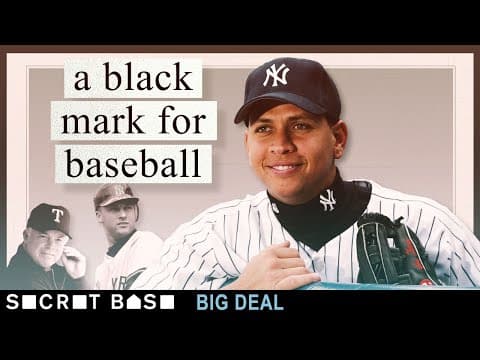
Alex Rodriguez's switch from shortstop to third base when he joined the Yankees in 2004 was a pivotal moment in baseball history. This blog explores the circumstances leading to the trade, the implications for both A-Rod and the Yankees, and how it reshaped the landscape of Major League Baseball.
In 2004, the trade that sent Alex Rodriguez from the Texas Rangers to the New York Yankees was seen as a monumental shift in the world of baseball. This move not only altered the trajectory of A-Rod's career but also had significant implications for the teams involved and the sport as a whole. This blog delves into the reasons behind A-Rod's switch to third base, the challenges he faced, and the broader impact of this decision on Major League Baseball.
Before the trade, Alex Rodriguez was trapped in a difficult situation with the Texas Rangers. Despite being one of the best players in baseball, A-Rod found himself on a team that consistently finished in last place. His lucrative contract, signed in 2000 for $252 million over ten years, was a double-edged sword. While it made him the highest-paid player in sports history, it also limited the Rangers' ability to build a competitive team around him.
By July 2003, A-Rod expressed his dissatisfaction with the Rangers. He was frustrated with his performance, which was below his usual standards, and the team's inability to compete. He openly sought a trade, hoping to join a contender and enhance his legacy beyond individual statistics. However, the Rangers faced a dilemma: they needed to offload A-Rod's massive contract to improve their roster.
The trade discussions involved several teams, including the New York Mets and the Boston Red Sox. The Mets, despite A-Rod's childhood admiration for them, were not a viable option due to financial constraints and past grievances. The Red Sox, on the other hand, were interested but faced hurdles related to A-Rod's contract. They proposed a restructuring that would reduce his salary, but the players' union blocked this move, fearing it would set a dangerous precedent for future negotiations.
The turning point came when Yankees third baseman Aaron Boone suffered a season-ending injury. The Yankees, a perennial contender with the financial capability to absorb A-Rod's contract, became the most viable option. The idea of A-Rod switching to third base to accommodate Derek Jeter, the Yankees' star shortstop, emerged as a potential solution.
Switching from shortstop, a position where A-Rod had excelled and won multiple Gold Gloves, to third base was not an easy decision. It meant deferring to Jeter, a player with whom A-Rod had a complicated relationship. However, A-Rod's desire to escape Texas and join a winning team ultimately outweighed his reservations about the position change.
A-Rod's decision to join the Yankees and switch to third base was monumental. It was seen as a potential game-changer for the Yankees, who were expected to dominate the league with A-Rod in their lineup. The move was not just about A-Rod's personal ambitions; it had implications for the entire landscape of Major League Baseball.
The initial expectations for A-Rod's tenure with the Yankees were sky-high. However, the reality was more complex. In his first year, the Yankees faced a shocking defeat after leading the ALCS 3-0 against the Red Sox. A-Rod's performance in the postseason was scrutinized, and he faced criticism despite his regular-season success.
While A-Rod did achieve individual accolades, including MVP awards and a World Series title, the trade had broader implications. The Rangers, freed from A-Rod's contract, were able to rebuild and eventually reached the World Series in 2010, defeating the Yankees in the process. This outcome highlighted the importance of team dynamics in baseball, reinforcing the idea that individual talent alone does not guarantee success.
Alex Rodriguez's switch to third base and his trade to the Yankees was a pivotal moment in baseball history. It reshaped the careers of both A-Rod and the teams involved, illustrating the complexities of contracts, team dynamics, and the pursuit of legacy in professional sports. While the trade did not lead to the dominance many expected, it ultimately changed the landscape of Major League Baseball, proving that sometimes, the most significant moves are not just about individual players but about the teams and the sport as a whole.