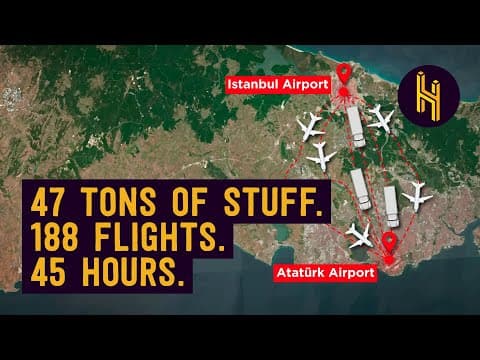
In April 2019, Istanbul successfully relocated its main airport from Ataturk to the newly built Istanbul Airport in just 45 hours, showcasing exceptional planning and logistics that involved moving over 47,000 tons of equipment and 188 aircraft with minimal disruption to air traffic.
On April 5th, 2019, at 3:00 a.m. local time, Istanbul's main airport was Ataturk International Airport (IST). By midnight the following day, the bustling hub had officially transitioned to the newly constructed Istanbul Airport (IST). This monumental move involved relocating an entire airport operation across one of the world's largest cities in just 45 hours, all while maintaining air traffic flow.
Ataturk Airport had been in operation for 86 years and was handling 64 million passengers annually, far exceeding its designed capacity. The airport lacked the necessary space for expansion and could not accommodate larger aircraft like the Airbus A380, which other major airports in Europe and the Middle East could. Turkish President Recep Tayyip Erdoğan envisioned a larger, more modern airport to showcase Turkey's growing influence, leading to the construction of the new Istanbul Airport at a staggering cost of $8 billion.
While the new airport promised to enhance Turkey's global standing, it was not without controversy. Questions arose regarding the project's affordability and the safety of its construction, with reported fatalities ranging from 27 (government figures) to nearly 400 (according to independent sources). However, these discussions are beyond the scope of this article.
The new Istanbul Airport officially opened in October 2018, but it initially operated with fewer than 20 flights per day. To facilitate a successful transition, extensive planning was required. The move involved two years of preparation, including numerous meetings with government officials, logistics firms, and crisis centers to ensure a smooth operation.
The move entailed transporting a staggering 47,360 tons of equipment, including:
In total, 10,459 pieces of equipment covering 262 acres were meticulously loaded, transported, and unpacked using 1,557 vehicles, primarily large blue container trucks. If lined up, these trucks would stretch approximately 80 kilometers, nearly the distance between Ataturk and Istanbul Airport.
During the 45-hour transfer period, both airports remained operational, necessitating intricate scheduling. At 3:00 a.m. on April 5th, commercial passenger flights were halted at Istanbul Airport, allowing only transfer flights to begin moving aircraft from Ataturk. A traffic limit of 70 arrivals and departures per hour was enforced across both airports.
At 2:59 a.m. on April 6th, the IATA codes for the airports were officially swapped, with Istanbul Airport adopting IST and Ataturk becoming ISL. By 2:00 p.m. that day, Turkish Airlines commenced commercial flights from the new airport.
In the week following the move, Ataturk Airport's air traffic was limited to just 10 arrivals and departures per hour, while Istanbul Airport operated at a capacity of 70 arrivals and departures until April 20th, when it increased to 80. The new Istanbul Airport was designed to handle 90 million passengers annually, and by 2023, it was already serving 76 million passengers, surpassing Ataturk's final capacity.
The successful relocation of Istanbul's airport in just 45 hours stands as a testament to meticulous planning and execution in logistics. The operation not only minimized disruption to air traffic but also showcased Turkey's ambition to enhance its global aviation presence. As Istanbul Airport continues to grow, it remains a remarkable example of what can be achieved through effective coordination and determination in the face of logistical challenges.