Venezuela's liberation from Maduro's regime is a significant positive change after years of economic collapse and suffering. Despite uncertainties and geopolitical interests, many Venezuelans are hopeful for stability and peace. The fall of Maduro, facilitated by external forces, opens a new chapter for the country once known for its beauty and potential.
Venezuela has recently experienced a monumental shift with the fall of its long-standing dictator, Nicolás Maduro. This event has sparked widespread discussion about the implications for the country and its people. Many are asking: Is this a good thing? The answer, according to many observers and those close to the situation, is a resounding yes.
Nicolás Maduro's tenure as the leader of Venezuela has been marked by severe hardship for the Venezuelan people. Maduro was widely regarded as a leader who prioritized his own interests over those of his citizens. His governance led to economic collapse, widespread poverty, and the erosion of basic freedoms.
One personal account highlights the extent of the suffering: the family of a Venezuelan woman, whose husband shared this story, had their land and business confiscated under Maduro's rule. This experience is not unique but rather emblematic of the struggles faced by many Venezuelans during this period.
The country's economy deteriorated drastically, with the national currency becoming almost worthless. Many Venezuelans were forced to leave the country temporarily to find work abroad, only to return home despite the challenges. This demonstrates a strong attachment to their homeland and a desire to rebuild rather than abandon their country.
Contrary to some reports suggesting widespread anger, many Venezuelans are reportedly relieved and hopeful following Maduro's removal. The dire conditions under his regime had left the population desperate for change, and the current situation is seen as an improvement.
The liberation has brought a sense of optimism, even though the future remains uncertain. People are cautiously hopeful that stability and peace will return to Venezuela, a country once celebrated for its natural beauty and potential.
The topic of Venezuela's vast oil reserves frequently arises in discussions about international involvement. It is widely believed that the United States' intervention was motivated by the desire to control these resources.
While some may view this as a purely strategic move, it is important to recognize the complex geopolitical dynamics at play. The former U.S. President Donald Trump, for instance, is often cited as having interests aligned with securing Venezuelan oil, though opinions about his motivations vary.
Maduro's capture was surprisingly swift and uncomplicated, likened to ordering a ride on a delivery app and having him picked up and removed without significant resistance. During the U.S. military's actions, Venezuela's defense was minimal, with reports of only a single tank being deployed in response to bombings of military bases.
This lack of robust defense underscores the weakened state of Maduro's regime and the military's diminished capacity.
The personal narrative shared by the narrator, whose wife is Venezuelan and whose parents are from Iraq, draws parallels between the struggles faced by different nations under oppressive regimes. This connection highlights the universal desire for freedom and justice.
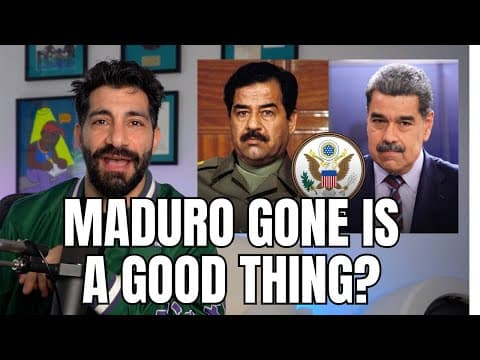
A humorous observation was made about dictators with mustaches being disliked by America, suggesting that perhaps a simple change in appearance might influence international relations.
The current vice president of Venezuela has distanced herself from Maduro, signaling potential shifts in the country's political landscape. However, the path forward remains uncertain.
What is clear is the need for prayers and support for Venezuela's people as they navigate this transitional period. The hope is that Venezuela can regain its former glory and become a thriving nation once again.
The fall of Nicolás Maduro represents a pivotal moment in Venezuela's history. While challenges remain, the liberation offers a chance for renewal and progress. The resilience of the Venezuelan people and their commitment to their homeland provide a foundation for optimism.
As the situation develops, the world watches with hope that Venezuela will find peace, stability, and prosperity in the years to come.
Let us all keep Venezuela in our thoughts and support their journey toward a better future.