
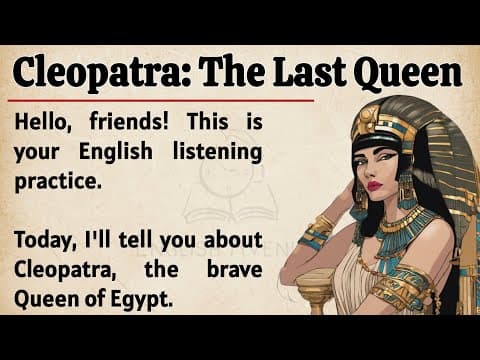
Cleopatra, the last queen of ancient Egypt, rose to power through intelligence, charm, and strategic alliances. Her life was marked by ambition, love affairs with Julius Caesar and Mark Anthony, and ultimately, tragedy. Despite her downfall, Cleopatra's legacy as a powerful leader and symbol of resilience endures.
Cleopatra, the last queen of ancient Egypt, is one of the most famous women in history. Her life is a captivating tale filled with drama, power, love, and ambition. This blog post takes you on a journey through her incredible story, perfect for English practice and rich in historical significance.
Over 2,000 years ago, in 69 BCE, a baby girl named Cleopatra VII was born in Alexandria, Egypt. She would grow up to become a queen like no other. Born into the Ptolemaic dynasty, Cleopatra's family had ruled Egypt for many years, but they were originally from Greece. Her ancestor, Ptolemy I, was one of Alexander the Great's generals who became king of Egypt after Alexander's death.
Cleopatra's father was King Ptolemy XII, and her mother might have been Cleopatra V, though historians are uncertain about her identity. Growing up in a palace filled with luxury, Cleopatra had servants, beautiful clothes, and the best education. However, life in a royal family was fraught with danger, as family members often fought for power, sometimes even killing each other.
From a young age, Cleopatra learned that knowledge was power. Unlike most women of her time, she was educated and studied hard, learning many languages, including Greek, Latin, Egyptian, and Hebrew. It is said she could speak at least seven languages fluently, which was rare and made her stand out.
Despite her privileged upbringing, Cleopatra faced challenges. Her father was not a strong ruler, and many Egyptians viewed him as weak. When Cleopatra was around 14, her mother disappeared, and her father fell ill. Soon, Cleopatra found herself preparing to fight for the throne, even as a teenager. She respected Egyptian traditions and was the first Ptolemaic ruler to learn the Egyptian language, presenting herself as the goddess Isis.
At 18, Cleopatra's father passed away, leaving her to rule Egypt alongside her younger brother, Ptolemy XIII, who was only 10 years old. Cleopatra believed she was more capable and smarter than her brother, having studied languages, history, and politics, while he was just a child.
Initially, Cleopatra tried to work with her brother, but their advisors plotted against her, preferring to control the younger king. Cleopatra was forced to flee to the desert, wandering without a throne or army. However, she was determined not to give up.
During her exile, Cleopatra sought help from Julius Caesar, a powerful Roman general. To capture his attention, she devised a dramatic plan. One night, she had her servant wrap her in a carpet and present her to Caesar as a gift. When the carpet was unrolled, Cleopatra emerged, stunning and confident. Impressed by her intelligence and ambition, Caesar agreed to help her reclaim her throne.
Together, they defeated Ptolemy XIII and his advisors, restoring Cleopatra as queen. She worked closely with Caesar to strengthen Egypt, introducing new policies and improving trade.
With her throne regained, Cleopatra's life was still tumultuous. Her relationship with Julius Caesar was not just political; it was also romantic. Cleopatra admired Caesar's strength and intelligence, while he was captivated by her beauty and charm.
In 47 BCE, Cleopatra gave birth to a son named Ptolemy Caesar, known as Caesarion. She envisioned him as a symbol of unity between Egypt and Rome. However, their relationship faced challenges, particularly from Roman senators who viewed Cleopatra as a threat.
When Caesar returned to Rome, he invited Cleopatra to join him. She arrived in Rome with grandeur, showcasing Egypt's wealth. However, her presence stirred resentment among Roman women and political figures.
Tragedy struck in 44 BCE when Julius Caesar was assassinated. Cleopatra, fearing for her life, fled back to Egypt, determined to continue ruling with wisdom and courage. She prepared her son to be a strong leader, knowing Egypt needed a powerful ally.
After Caesar's death, Cleopatra's life took another dramatic turn when she met Mark Anthony, a powerful Roman leader. Seeking Egypt's support, Anthony sent for Cleopatra to discuss an alliance. Cleopatra seized the opportunity to impress him.
She made a grand entrance in Tarsus, sailing on a golden ship dressed as the goddess Aphrodite, surrounded by beautiful servants. Anthony was captivated, and their relationship blossomed into a passionate romance. They spent time together in Egypt, enjoying lavish banquets and dreaming of a united empire.
However, their relationship was not without complications. Anthony's alliance with Cleopatra angered Octavian, Caesar's adopted son, leading to political tensions. Octavian accused Cleopatra of bewitching Anthony, and their rivalry escalated into war.
Cleopatra and Anthony prepared to fight for their love and kingdoms against Octavian. The Battle of Actium in 31 BCE was a pivotal moment. Despite their bravery, Octavian's forces proved too strong. During the battle, Cleopatra's ship retreated, leading Anthony to believe she had betrayed him.
Heartbroken, Anthony returned to Egypt, where he and Cleopatra reunited. However, they faced overwhelming odds as Octavian's army advanced. In a final battle, Anthony was defeated, and believing Cleopatra was dead, he took his own life.
Cleopatra, determined to control her fate, chose to end her life on her own terms. She arranged for a poisonous snake to bite her, dying in her royal chamber. Her death marked the end of the Egyptian Kingdom, as Octavian took control and Egypt became part of the Roman Empire.
Cleopatra's legacy, however, endures. She is remembered not just as a queen but as a symbol of strength, resilience, and courage. Her story teaches us that even in the face of great challenges, we can stand strong and fight for what we believe in. Cleopatra's life inspires us to dream big and never let fear stop us, proving that women can be powerful leaders and warriors.
Let Cleopatra's story remind you that no matter how hard life gets, you have the power to rise above it.



















