
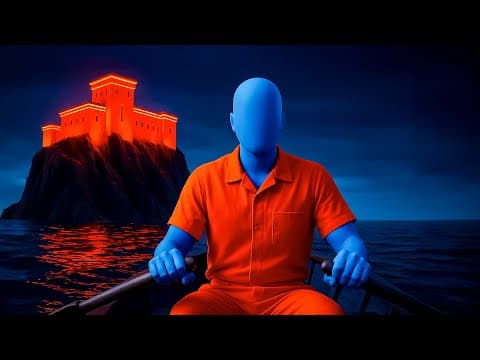
This article recounts the gripping true story of Billy Hayes, an American who was imprisoned in Turkey for drug smuggling and his daring escape from the notorious Imrali Island prison. It details his initial smuggling attempts, harsh prison experiences, ingenious escape plan involving a stolen knife and a wooden boat, and the aftermath including media attention and the impact of the film Midnight Express.
On October 2nd, 1975, under the cover of darkness, Billy Hayes, an American prisoner sentenced to decades in a notorious Turkish prison on Imrali Island, embarked on a desperate and daring escape. Armed with only a stolen knife and a small wooden boat, he braved freezing seas, armed guards, and his own fears to reclaim his freedom. This is the comprehensive story of his journey, from his early life to his eventual escape and the aftermath.
Billy Hayes' story begins in his teenage years when he first tried smoking hashish. He quickly became enamored with it and began smoking regularly. By 1967, at age 20, Billy was studying at university but decided to drop out, feeling bored and eager to explore the world. He took a job as an assistant at a local hospital to earn money.
During his time at the hospital, Billy observed the process of applying plaster casts for broken legs and thought it was a simple technique he could replicate. Around this time, a friend returned from Istanbul, Turkey, bringing back high-quality Turkish hashish, which was sold openly on the streets there.
Inspired by the availability and quality of Turkish hash, Billy planned to travel to Istanbul to procure hash and smuggle it back to the United States. He combined this idea with the hospital cast technique, intending to hide hash inside a plaster cast on his leg.
In 1969, Billy traveled to Istanbul, where a taxi driver quickly identified his intent to buy hash. The driver took him to his home, where Billy was introduced to the family and sampled the hash. He purchased two kilos for $300, a bargain even by today's standards.
Billy then crafted a plaster cast on his leg, securing the hash inside with adhesive tape and plaster bandages. The cast hardened overnight, and the next day, he passed through airport security with minimal inspection and boarded a plane to New York.
Upon arrival at JFK Airport, Billy noticed pieces of his cast crumbling and falling to the ground, risking exposure. Despite his fear, he managed to exit the airport unnoticed. He sold the hash at a significant profit, turning $300 into $5,000.
Billy repeated this smuggling operation two more times, each time refining his method. On his second trip, he taped hash bags around his stomach and chest under a loose winter coat, successfully passing through security again.
In September 1970, following a series of airplane hijackings in the Middle East, airport security tightened significantly. On his fourth trip, Billy observed increased security measures, including searches at the airplane door.
Attempting to evade detection, Billy tried to stay hidden on the bus transporting passengers to the plane but was eventually caught during a body search. Soldiers mistook the hash for a bomb initially, leading to a tense standoff before his arrest.
Billy was taken to Bayrampaşa Prison in Istanbul, where he experienced harsh conditions, including cold cells without blankets. Communication was difficult due to language barriers. He was sentenced to 4 years and 2 months for possession of hashish, a relatively light sentence compared to trafficking charges.
Life in prison was brutal, with frequent violence among inmates. Billy learned Turkish to communicate better and began contemplating escape plans, including using the train line to Greece.
Billy feigned mental illness to be transferred to Beckerui Psychiatric Hospital, where security was less strict. However, the environment was chaotic, filled with dangerous criminals suffering from mental disorders.
His friend Patrick, who was helping him obtain fake documents for escape, was found murdered in Istanbul, a victim of criminals who stole the money intended for the documents. This devastating news crushed Billy's spirit.
After his observation period, Billy was declared sane and returned to prison. He resolved to serve his sentence quietly. However, the Turkish Supreme Court later changed his charge to drug smuggling, increasing his sentence to 30 years or life imprisonment.
Billy was transferred to Imrali Island prison, a high-security facility surrounded by the sea, which served as a natural barrier to escape.
Imrali Island prison was more like a labor camp, with prisoners allowed to move around the island and work in a canning factory. Billy observed the boats used to transport goods to the island, focusing on them as his potential means of escape.
On the night of October 2nd, 1975, during an approaching storm, Billy noticed the boats remained docked. Seizing the opportunity, he retrieved a stolen knife hidden under his mattress and slipped out through a window.
He avoided guards by memorizing their patrol patterns and reached the dock. After cutting the rope tying a small wooden boat to a larger one, he hid in the small boat as the owner briefly appeared on the larger boat.
Once the coast was clear, Billy rowed away from the island, battling freezing waters and exhaustion. At dawn, he reached the shore of the nearby Bersa province.
Billy took a taxi to central Bersa and then a bus to Istanbul. He stayed at a Hilton hotel, hoping to find help from a friend who had been released from the island prison, only to learn the friend had returned to Afghanistan.
Studying maps, Billy planned to reach Greece by crossing the Maritza River at the border near Edirne. He carefully avoided Turkish border guards and swam across the river to Greek territory.
In Greece, Billy was detained and interrogated for two weeks but was eventually handed over to American authorities in Frankfurt, Germany. After further questioning, he was allowed to return to the United States on October 24, 1975.
Billy's escape story quickly went viral in the US, with media outlets and journalists covering his dramatic journey. He appeared on television and announced plans to write a book.
In 1977, his book "Midnight Express" was published, followed by a 1978 film adaptation. The movie, however, distorted many details and portrayed Turkey negatively, causing diplomatic tensions.
Billy later apologized for the film's portrayal and visited Turkey in 2007 to reconcile.
Billy Hayes' story is a remarkable tale of courage, resilience, and the human spirit's desire for freedom. From his initial smuggling attempts to his harrowing escape from Imrali Island prison, his journey captivates and inspires. Despite the hardships and losses, Billy's determination led him to reclaim his life and share his story with the world.
If you found this story compelling, consider exploring more about Billy Hayes and the historical context of his experiences.



















