
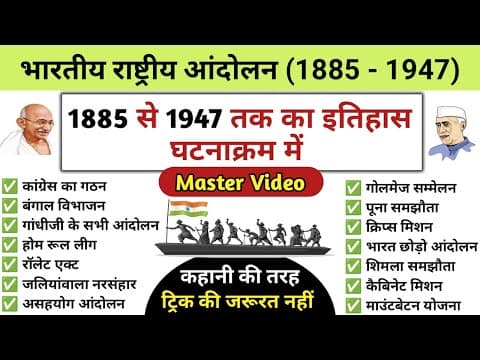
This blog post provides a detailed overview of the Indian National Movement from its inception in 1885 with the formation of the Indian National Congress to the independence of India in 1947, highlighting key events, figures, and movements that shaped the struggle for freedom.
The Indian National Movement was a pivotal period in the history of India, spanning from 1885 to 1947. This blog post aims to encapsulate the significant events and milestones of this movement in a narrative format, making it easier to understand the evolution of India's struggle for independence.
The journey of the Indian National Movement began with the establishment of the Indian National Congress (INC) on December 28, 1885, at the Gokuldas Tejpal Sanskrit School in Mumbai. The Congress was initially formed as a platform for the educated elite to discuss political issues and was seen as a means for the British to manage Indian aspirations. The first president of the Congress was Womesh Chunder Bonnerjee, and it was later renamed the Indian National Congress by Dadabhai Naoroji.
The song "Vande Mataram," written by Bankim Chandra Chatterjee, was first sung at the Kolkata Congress session in 1896, marking a significant cultural moment in the movement.
In 1905, the British government announced the partition of Bengal, ostensibly for administrative reasons. However, the real motive was to divide the Hindu and Muslim communities. The partition was implemented on October 16, 1905, leading to widespread protests and a strong sense of unity among Indians against British rule.
In response to the growing influence of the INC, the All-India Muslim League was formed in 1906, advocating for the rights of Muslims in India. It was established under the leadership of Nawab Salimullah Khan.
The Congress faced internal divisions in 1907, leading to a split between the moderates and extremists. The split was marked by the Surat session, where leaders like Bal Gangadhar Tilak, Lala Lajpat Rai, and Bipin Chandra Pal emerged as prominent figures of the extremist faction.
The early 20th century saw the rise of revolutionary movements against British rule. Notable figures included:
The First World War (1914-1918) significantly impacted India. Mahatma Gandhi returned from South Africa in 1915 and began advocating for Indian participation in the war, believing it would lead to concessions from the British.
In 1916, the Home Rule League was established by Bal Gangadhar Tilak and Annie Besant, demanding self-governance for India.
The Jallianwala Bagh massacre on April 13, 1919, was a turning point in the Indian independence movement. British General Dyer ordered troops to fire on a peaceful gathering, resulting in hundreds of deaths and injuries, igniting widespread outrage across the country.
In response to the Jallianwala Bagh massacre and the Rowlatt Act, Gandhi launched the Non-Cooperation Movement in 1920, urging Indians to withdraw from British institutions and promote swadeshi (self-reliance).
The Civil Disobedience Movement began with the Dandi March on March 12, 1930, where Gandhi and his followers marched to the sea to produce salt, defying British laws. This act of nonviolent resistance galvanized the Indian populace against colonial rule.
The British government convened three Round Table Conferences in London to discuss constitutional reforms. However, the Congress boycotted the first conference, and the subsequent conferences failed to yield significant results.
The Quit India Movement, launched in August 1942, called for an end to British rule in India. It was marked by widespread protests and the arrest of many leaders, including Gandhi, who was imprisoned in the Aga Khan Palace.
The culmination of the Indian National Movement came on August 15, 1947, when India gained independence. However, this was accompanied by the partition of India into two nations: India and Pakistan, leading to significant communal violence and displacement.
The Indian National Movement was a complex and multifaceted struggle that involved various leaders, ideologies, and events. From the formation of the Indian National Congress to the eventual independence of India, this period was marked by significant sacrifices and a relentless pursuit of freedom. Understanding this history is crucial for appreciating the values of democracy and self-governance that India upholds today.



















