
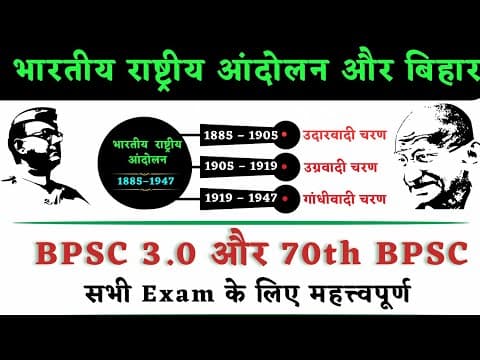
This blog post provides a detailed account of the Indian National Movement from 1885 to 1947, focusing on significant events, key figures, and the role of Bihar in shaping the movement. It covers the establishment of the Indian National Congress, major movements like the Non-Cooperation Movement, the Civil Disobedience Movement, and the Quit India Movement, along with the impact of World War II and the eventual independence of India.
The Indian National Movement, spanning from 1885 to 1947, was a pivotal period in Indian history that saw the struggle for independence from British rule. This blog post delves into the key events, figures, and the significant role played by Bihar in this movement.
The Indian National Congress (INC) was founded in 1885, marking the beginning of organized political activity in India. The primary motivation behind its establishment was the rise of nationalism among Indians, fueled by the exploitation and oppressive policies of the British. The first session of the INC was held in Bombay, with A.O. Hume as one of its key founders.
Launched by Mahatma Gandhi, the Non-Cooperation Movement aimed to resist British rule through non-violent means. It called for the boycott of British goods, institutions, and honors.
This movement was characterized by the refusal to obey certain laws, demands, and commands of the British government. The Salt March, led by Gandhi in 1930, was a significant event that galvanized public support.
Launched in August 1942, the Quit India Movement called for an end to British rule in India. It was marked by widespread protests and a call for immediate independence.
Bihar played a crucial role in the Indian National Movement, with several leaders emerging from the state who contributed significantly to the struggle for independence.
The Indian National Movement was a collective effort that involved various strategies, ideologies, and leaders. Bihar's contribution to this movement was significant, with its leaders playing pivotal roles in shaping the course of India's struggle for independence. The period from 1885 to 1947 was marked by resilience, sacrifice, and a relentless pursuit of freedom, culminating in the independence of India in 1947.



















