
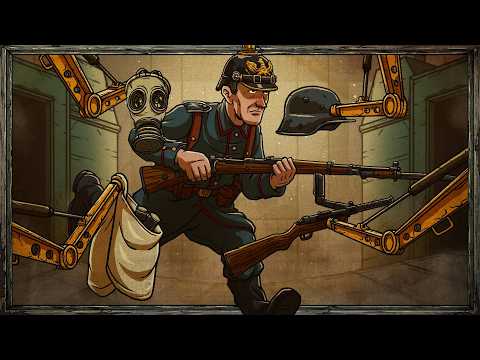
The Industrial Revolution fundamentally changed warfare, leading to the development of advanced weaponry, mass mobilization, and the concept of Total War, culminating in the unprecedented destruction of World War I.
On September 15th, 1916, the sounds of machinery and metal clanking filled the air in Chilwell, England. The products of its burgeoning factories were being transformed into artillery shells, which were then hurled across the horizon, marking a significant moment in the industrialization of warfare. This transformation was not merely a result of technological advancements but also a consequence of over a century of changes initiated by the Industrial Revolution.
The Industrial Revolution, characterized by innovations such as the steam engine, led to a cascade of technological breakthroughs that dramatically altered human capabilities. New sources of energy from fossil fuels replaced traditional muscle power, enabling goods to be produced on an unprecedented scale. As these advancements spread globally, they brought about significant social changes, particularly in urbanization. Large manufacturing centers required vast workforces, leading to a population explosion in cities as people migrated from rural areas.
The societal transformation also reverberated through government structures. The wealth generated by industry allowed nations to grow their economies rapidly, even without direct access to natural resources. More importantly, the Industrial Revolution equipped states with the technology to control their expanding populations, enabling bureaucracies to mobilize citizens effectively.
Despite the potential of industrialization, its impact on warfare was initially inconsistent. While Napoleon effectively conscripted large armies, many 19th-century rulers preferred smaller, loyal forces. Military planners were often hesitant to adopt new tactics or technologies, clinging to traditional methods despite the clear advancements in warfare capabilities.
However, by the mid-19th century, the pressure of industrialization on military practices became undeniable. The period between 1853 and 1865 saw the Crimean War and the American Civil War erupt into widespread destruction, revealing a roadmap to industrial warfare.
The military revolution was first evident at sea, where industrial navies deployed steamships, gaining advantages over those that did not embrace industrialization. The effectiveness of modern seaborn artillery was showcased in 1853 when a Russian fleet decimated an Ottoman flotilla with explosive shells. This led to a race for developing advanced warships, culminating in the first clash of ironclads during the American Civil War, which demonstrated the effectiveness of armored vessels.
On land, new weaponry made battlefields increasingly deadly. Innovations such as rifling and breach-loading significantly improved the accuracy and speed of firearms. By the late 1860s, it was possible to equip armies with rifles in a fraction of the time it had taken just decades earlier. This shift rendered cavalry nearly obsolete and emphasized the importance of artillery, particularly after the American Civil War, where Prussian forces showcased the effectiveness of steel breach-loading artillery.
Despite these advancements, military leaders often failed to adapt their tactics, leading to catastrophic losses in battles where traditional head-on engagements were employed against fortified positions. The introduction of trench warfare marked a significant shift in combat, as defenders gained the upper hand with rapidly firing rifles and accurate artillery.
The railroad revolutionized the logistics of warfare, allowing for the rapid deployment of troops and supplies. Prussia's ability to transport large numbers of soldiers by rail during conflicts demonstrated the strategic advantage of industrialized transportation. This capability led to the concept of Total War, where entire nations mobilized their resources for military conflict, making every citizen and piece of property a potential target.
The American Civil War exemplified this concept, as the Union leveraged its manufacturing capabilities to outproduce the Confederacy. European powers soon followed suit, using industrialization to project their influence globally, leading to the expansion of colonial empires.
As the 19th century drew to a close, the disparate elements of industrial warfare converged. States had unprecedented power to mobilize populations and industries for war, and the line between civilian and soldier blurred. The assassination of Archduke Franz Ferdinand on June 28, 1914, plunged Europe into conflict, leading to a war characterized by industrial-scale destruction.
Germany's initial strategy aimed to avoid a two-front war through a rapid advance into France and Belgium. However, the defensive advantages of industrial warfare had grown significantly, with extensive trench systems and mass-produced barbed wire creating formidable obstacles. The introduction of the machine gun further solidified the defensive position, as these weapons could unleash devastating fire on advancing troops.
As World War I progressed, the concept of Total War became fully realized. Nations expanded their industries to support the war effort, implementing mass conscription and commandeering resources for military use. New technologies emerged, including airplanes for reconnaissance and artillery that could devastate trench systems.
The development of tanks provided a potential solution to break through entrenched defenses, and by the war's end, hundreds of these armored vehicles were deployed in coordinated attacks. Ultimately, the war was not won through brilliant tactics but through the ability to outproduce and outlast the enemy, particularly after the United States entered the conflict.
The First World War starkly illustrated how industrial and technological advancements transformed warfare into a scale of destruction previously unimaginable. The conflict set the stage for future wars, where the mechanization of warfare continued to evolve, as seen in modern conflicts today. The legacy of industrial warfare remains evident, with contemporary technologies extending the reach and lethality of conflict while distancing those who control it from the battlefield.



















