
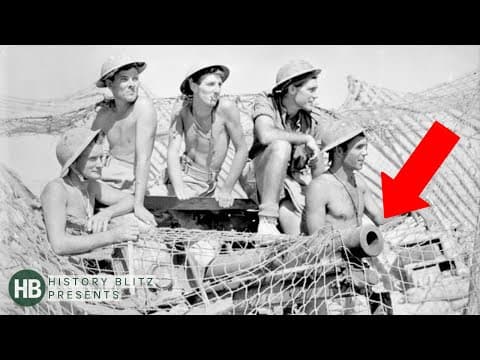
In April 1941, the Australian 9th Division, under Major General Sir Leslie Morshead, executed a brilliant defensive strategy at Tobruk that thwarted Field Marshal Erwin Rommel's blitzkrieg tactics, marking the first defeat of German forces in World War II.
In April 1941, the barren Libyan Desert became the stage for one of the most significant confrontations of World War II. Field Marshal Erwin Rommel, one of Nazi Germany's most celebrated commanders, prepared to unleash his Africa Corps in a bid to capture the heavily fortified town of Tobruk. After only two months of rapid advances, Rommel had pushed British and Commonwealth forces back to the Egyptian border, earning him the nickname "The Desert Fox."
Tobruk was not just another town; it was a vital strategic location during World War II for several reasons:
The capture of Tobruk would have brought Axis forces closer to Egypt and the Suez Canal, threatening Britain's global supply lines and access to oil from the Middle East.
In January 1941, Australian troops, as part of the Allied Western Desert Force, engaged in their first major land battle of the war, capturing Tobruk from Italian forces. Despite being outnumbered, the Allied forces managed to defeat the larger Italian army, capturing approximately 130,000 troops.
In early February, Rommel was sent to support the Italians and prevent a collapse of Axis forces in North Africa. British intelligence intercepted communications indicating that Rommel's forces would arrive gradually, leading to a reduction of British troops in the region. The newly formed 9th Australian Division arrived in Libya, albeit under-equipped and with limited training.
By April 1941, Rommel had surrounded Tobruk on three sides, trapping the Australian defenders inside. The garrison, under Major General Sir Leslie Morshead, was composed of the 9th Australian Division, the 18th Brigade of the 7th Australian Division, British artillery regiments, and the 3rd Indian Motor Brigade. Morshead famously declared, "There will be no Dunkirk here; if we should have to get out, we shall fight our way out. There is to be no surrender and no retreat."
Rommel planned to employ his blitzkrieg tactics, which had proven successful in Europe and North Africa. However, Morshead had a counter-strategy that would catch the Germans by surprise.
Morshead's defense was characterized by a tactic known as "defense in depth." Instead of holding the front lines rigidly, the Australians allowed German tanks to penetrate their defenses, only to engage them with artillery and infantry from behind. This tactic was unprecedented and effectively neutralized the German blitzkrieg approach.
On the night of April 13th, the Germans launched their first major assault. Confident in their strategy, they pushed their tanks through the Australian lines, only to find themselves ambushed. The Australians engaged the tanks from multiple sides, utilizing artillery at point-blank range, inflicting heavy losses on Rommel's forces.
Over the following days, Rommel attempted several more attacks, but each time, the Australians held their ground, forcing the Germans to retreat. In one notable counterattack, the Australians captured a significant portion of Rommel's Italian Trento Division.
For the next 242 days, the Axis forces laid siege to Tobruk, bombarding the defenders with artillery and air assaults. The defenders, dubbed the "Rats of Tobruk" by German propagandists, embraced the name as a badge of honor, showcasing their resilience and determination.
Morshead's strategic genius and the grit of the Australian troops ultimately brought Rommel's offensive to a halt. Originally ordered to defend for eight weeks, the Australians held Tobruk for eight months, until relieved by the British 6th Division in October 1941.
Today, a plaque in Victoria, Australia, commemorates the bravery of the 14,000 Australians who fought at Tobruk, enduring the harsh conditions of the Libyan desert while repelling the German forces. Their tenacity and strategic ingenuity not only marked the first defeat of the all-conquering German forces in World War II but also solidified their legacy as the "Rats of Tobruk," a symbol of pride and resilience in Australian military history.



















