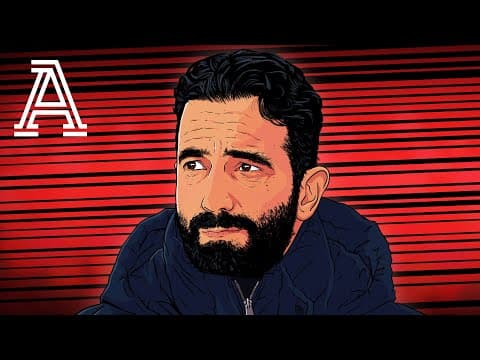
Ruben Amorim was hired as Manchester United's head coach in November 2024 with strong backing but was sacked 14 months later due to tactical disagreements, recruitment conflicts, and a breakdown in trust with the club's leadership. Key issues included his insistence on a back three system, player selection controversies, and a major fallout with director of football Jason Wilcox.
It has been two weeks since Ruben Amorim was sacked as Manchester United's head coach. When he was hired in November 2024, Amorim was seen as an exciting young project coach, precisely the kind considered required for the job. However, just 14 months later, he was already gone. So, what actually happened to cause this unexpected ending?
When Manchester United fired Eric ten Hag in October 2024, the club's sporting director at the time, Dan Ashworth, initially recommended candidates with Premier League experience to replace him. However, the club's chief executive, Omar Berrada, decisively backed Ruben Amorim. Meanwhile, technical director and now director of football, Jason Wilcox, initially had reservations about picking a manager so wedded to a back three formation.
From the outset, Amorim had told executives that he wanted to start at United with a back three, but that he would add layers once players better understood his methods. Amorim was hired, and Ashworth left the club two months later.
Amorim perhaps sensed that he was Sir Jim Ratcliffe's appointment, after a prolonged one-on-one interview with the United minority owner before he got the job. He seemed in a position of strength when the club backed his decision to consign Marcus Rashford, Antony, Jadon Sancho, and Alejandro Garnacho to what became known as the "bomb squad." Some at United told The Athletic that they felt this had reduced Garnacho's value by 15 million pounds. Amorim was later challenged on this decision by United's former chief executive David Gill at a football board meeting at Old Trafford. Nevertheless, the club felt they were backing their manager and did so again when they accepted Amorim's wish to scrap a behind-the-scenes Amazon documentary.
As time went on, Amorim felt his power eroding. When it came to recruitment of a striker, his preference had been Premier League proven Ollie Watkins, but United's director of recruitment, Christopher Vivell, advocated for the younger Benjamin Sesko, who ultimately arrived. This was not seen as too big an issue.
However, the decision to recruit the younger, cheaper goalkeeper Stefan Loncar over Amorim's preference for the more experienced Emi Martinez was more keenly felt. Amorim also felt that United hadn't given their all to sign Antoine Semenyo. In the summer of 2025, Semenyo even dined with Amorim and Manchester United's director of football Jason Wilcox in London, only for United to switch targets to Imbmo because they viewed Bournemouth's 70 million pound asking price for Semenyo as too high.
Imbmo was projected as costing at most 55 million pounds, although eventually Brentford pushed the fee to 65 million plus 6 million pounds in add-ons. Semenyo was disappointed that he'd been rejected for a player who ended up at the same valuation, and he seemed in no rush to answer United's call a second time around in January, before ultimately joining Manchester City instead.
During the talks, Amorim had told Semenyo that he would play as a left winger in a 4-3-3 formation.
Confusion about tactics became an issue of contention as Amorim's reign went on at United. Sir Jim Ratcliffe had opinions on how the team should play. He suggested earlier in the season using Imbmo at wing back and wanted United to switch to a back four.
Ratcliffe was seen visibly angry at the sloppy manner in which United conceded an equalizer right before halftime in the 4-1 win away to Wolves. The job of communicating this to Amorim fell to Wilcox, who, despite his preference for a 4-3-3 formation that had been so successful at Manchester City, where he'd previously been academy director, was actually seen as one of Amorim's big allies.
Wilcox and Amorim would talk daily, including about formations, but until late in Amorim's reign, this didn't translate into direct advice. As Ratcliffe's desire for change became clearer, Wilcox increased his efforts to persuade Amorim to show more flexibility.
Amorim did oblige to a degree by sending his team out in a predominantly 4-4-2 shape against Bournemouth on December 15th, and then a clear 4-3-1 shape against Newcastle United on Boxing Day. But when he reverted to his 3-4-2-1 for the 1-1 draw with Wolves on December 30th, the halftime substitution of Joshua Zirkzee, one of his few available senior attackers, concerned members of United's hierarchy.
Their senior leadership team, including Berrada and Wilcox, were seen leaving Old Trafford around 90 minutes after the final whistle, indicating prolonged conversations with Amorim were taking place.
This set the scene for what sources described as a "massive fallout" between Wilcox and Amorim three days later. In their face-to-face meeting at United's Carrington training ground, Wilcox suggested to Amorim that the players were struggling to gain trust in his 3-4-2-1 system and had become confused over his vision.
Amorim would train the team in a back four, only for a back three to be selected in games. They also sensed he lacked faith in them due to his selections and public statements. Amorim responded that the players needed to be changed. Wilcox said he wanted to work through the issues, evolving the squad over time but sticking with Amorim.
Amorim reacted by saying he wished to leave the club and would be calling his agent. When he then selected his 3-4-2-1 system, featuring just two attackers against Leeds, two days later, it appeared to those with knowledge of the situation that he was making it clear that if this was to be his last game, he would bow out his way.
And indeed, it proved to be exactly that. The next morning, he was officially sacked as Manchester United manager.
Ruben Amorim's tenure at Manchester United was marked by initial optimism but ultimately undermined by tactical inflexibility, recruitment disagreements, and a breakdown in trust with the club's leadership. His insistence on a back three system clashed with the preferences of key figures like Sir Jim Ratcliffe and Jason Wilcox, leading to confusion among players and staff. Recruitment decisions further strained relationships, and a major fallout with Wilcox precipitated his departure.
This episode highlights the complexities and challenges of managing a top football club where differing visions and power struggles can quickly unravel even the most promising projects.