
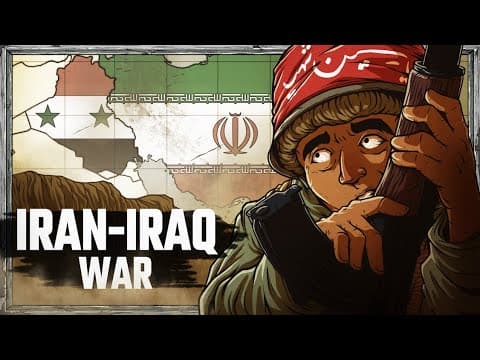
The Iran-Iraq War, beginning on September 22, 1980, was a protracted conflict influenced by political upheavals in both nations. It involved complex military strategies, significant human and economic costs, and ultimately reshaped the geopolitical landscape of the Middle East. Despite initial expectations of a quick victory, the war lasted nearly eight years, resulting in a stalemate and enduring consequences for both countries.
On September 22, 1980, Iraqi warplanes screamed over the Iranian Plateau, marking the beginning of a conflict that would reshape the Middle East. Initially expected to be a quick war, the Iran-Iraq War turned into a protracted struggle influenced by significant political revolutions in both nations.
The roots of the conflict can be traced back to the Ba'ath Party's seizure of power in Iraq on July 17, 1968. This party, which blended socialism, anti-imperialism, and Arab nationalism, installed Ahmed Hassan al-Baker as president, with Saddam Hussein as vice president. Over the next decade, Saddam enhanced Iraq's economy and infrastructure, eventually becoming president on July 16, 1979. His rule was marked by ruthless purges, including the execution of 22 party members, consolidating his absolute control.
Despite his harsh methods, Saddam's regime faced vulnerabilities. The Ba'ath Party was predominantly Sunni Muslim, while Iraq's majority was Shia Muslim, creating a continuous threat of revolt. Additionally, Iraq's significant non-Arab populations, particularly the Kurds, posed challenges to Saddam's Arab-centric ideology.
In 1979, turmoil unfolded in neighboring Iran, which had been a secular, Western-aligned autocracy under Shah Muhammad Raza Pahlavi. The Shah's extensive industrialization and alignment with the West fueled widespread discontent, culminating in the Iranian Revolution of 1978-1979. The revolution, despite its internal divisions, united many under Ruhollah Khomeini, a Shia cleric who later became known as the Ayatollah.
Amid the chaos in Iran, Saddam Hussein perceived both danger and opportunity. He viewed Khomeini's Shia theocracy as a threat to his Sunni-led regime in Shia-majority Iraq. Saddam's strategy involved claiming the Shatt al-Arab waterway and Iran's Arab-majority Khuzestan province, aiming to extend his influence and undermine Iran.
On September 22, 1980, Iraq invaded Iran, expecting a swift victory. However, the initial offensive did not go as planned. Iraqi aircraft aimed to surprise and disable Iran's American-equipped Air Force but failed to achieve decisive results, leading to Iran destroying about 30 Iraqi planes and gradually gaining air superiority.
On the ground, Iraqi Army units initially fared better, advancing along three fronts across the Iran-Iraq border. However, they faced unexpected resistance from Iranian forces, particularly in the southern city of Khorramshahr. Despite being vastly outnumbered and outgunned, Iranian forces engaged in intense urban warfare, effectively stalling the Iraqi offensive.
By late 1980, Iran's military was significantly weakened, suffering from desertions and purges in its officer corps. Nevertheless, the invasion unified Iranians under Khomeini's leadership, rallying them to defend their homeland.
Recognizing that the conflict would not be brief, Saddam adjusted his strategy. In January 1981, Iran shifted from defense to offense with Operation Nasser, targeting Iraqi siege lines. However, this operation failed, leading to political turmoil in Iran and internal conflict akin to a civil war.
As the war dragged on, both nations faced severe shortages of military supplies. Iran resorted to cannibalizing parts from its sophisticated equipment while discreetly obtaining spare parts from countries like the United States and Israel. Conversely, Iraq sourced arms from various countries, including the Soviet Union and France, but faced economic constraints due to declining oil revenues.
In September 1981, the dynamics of the war shifted as Iran aimed to recapture Abadan. This offensive took the Iraqis by surprise, leading to significant territorial gains for Iran. However, as the war continued, both nations resorted to increasingly brutal tactics, including the use of chemical weapons and child soldiers.
By 1985, the prolonged conflict had drained both nations, leading to a stalemate. A significant shift occurred in June 1986 when Iran captured the Al-Faw Peninsula, denying Iraq sea access and establishing an Iranian presence west of the Shatt al-Arab.
In 1987, Iran launched a major offensive known as Operation Karbala-5, aiming to seize Basra. Despite initial successes, the operation turned into a grueling siege, with neither side gaining substantial ground. The war's brutality escalated, with both nations employing inhumane tactics.
The tide turned in April 1988 with Iraq's Operation Blessed Ramadan, which successfully ousted Iranian forces from significant territorial gains. By July 1988, Iran and Iraq agreed to cease hostilities, returning to their pre-war borders after nearly eight years of brutal conflict.
Both Iran and Iraq claimed victory, but the aftermath of the war had complex and enduring consequences. In Iran, the revolution was preserved, potentially strengthening Khomeini's grip on power. However, the war inflicted massive economic losses, estimated in the hundreds of billions, and left extensive destruction across the country.
In Iraq, Saddam Hussein's regime remained intact, but his territorial ambitions were unmet, and the nation was burdened with crippling debt, much of it owed to Kuwait. The Iran-Iraq War set the stage for continued conflict in the Middle East, leaving a legacy of instability that would influence the region for decades to come.



















