
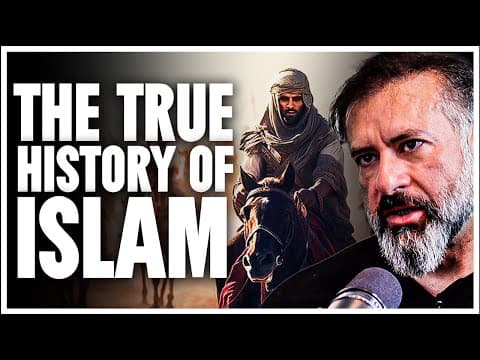
Raymond Ibrahim discusses the rapid Islamic conquest of Christian Europe within a century after Muhammad's death, the subsequent Crusades, and the ongoing persecution of Christians by Muslims globally. Drawing from his Egyptian Coptic heritage and academic background, Ibrahim sheds light on the overlooked and suppressed aspects of Islamic history in Europe and its modern-day implications.
The history of the Islamic conquest of Europe and its aftermath is a complex and often overlooked subject. Raymond Ibrahim, a historian of Egyptian Coptic descent, provides a detailed examination of this period, highlighting the rapid expansion of Islam into Christian Europe and the subsequent cultural and religious conflicts that shaped the continent's history.
Muhammad died in 632 AD, and within just one century, by 732 AD, Muslim forces had penetrated deep into Europe. They were engaged in battles, abducting people, and destroying churches. Contrary to some modern narratives that portray this era as a time of tolerance and cultural flourishing, Ibrahim describes the Muslim conquests as aggressive and destructive, likening their actions to "ISIS on steroids."
During this century, Muslims conquered approximately three-quarters of the original Christian world permanently. This dramatic expansion set the stage for the eventual Christian response known as the Crusades.
The term "Crusades" often carries a negative connotation in contemporary discourse, sometimes depicted as a diabolical or evil venture. However, Ibrahim emphasizes the effectiveness of the Crusades in countering the Islamic advance into Europe.
He points out that the dominant narrative surrounding the Crusades has been shaped to portray them negatively, overshadowing their historical context and significance. The Crusades were a direct response to the centuries-long Muslim incursions and the threat they posed to Christian Europe.
Ibrahim draws parallels between historical events and current issues, noting that Muslim persecution of Christians remains a significant but underreported problem. He cites ongoing violence against Christians in regions such as Congo and Nigeria, where dozens are killed weekly.
Despite the severity of these attacks, mainstream media often downplays or misattributes the causes, sometimes blaming unrelated factors like climate change. Ibrahim stresses the importance of acknowledging and addressing this persecution to understand the broader historical and cultural dynamics at play.
Looking ahead, Ibrahim highlights demographic shifts in Europe, particularly in Germany, where Muslims are projected to constitute around 40% of the population. He suggests that such changes could have profound implications for social cohesion and cultural identity in Europe.
Raymond Ibrahim's unique perspective stems from his Egyptian Coptic heritage and his academic pursuits. Born in 1973 to a family that emigrated from Egypt in the late 1960s, Ibrahim grew up bilingual, fluent in Arabic and English.
His interest in the intersection of Western civilization and Islam was influenced by his Christian background and familiarity with Islamic culture. In college, he majored in history, focusing on the Middle Ages, Medieval Islam, and the Byzantine Empire.
Ibrahim studied under Victor Davis Hanson, a renowned military historian, which further shaped his expertise. His master's thesis examined the first major battle between Christian and Muslim armies, laying the foundation for his extensive research and writings on the subject.
Raymond Ibrahim's insights shed light on a critical yet often suppressed chapter of European history—the Islamic conquest and its enduring impact. By understanding this history and its modern-day echoes, readers can gain a more nuanced perspective on the cultural and religious dynamics that continue to influence global affairs.
His work challenges prevailing narratives and encourages a deeper exploration of the historical realities that have shaped the relationship between Islam and the West.



















