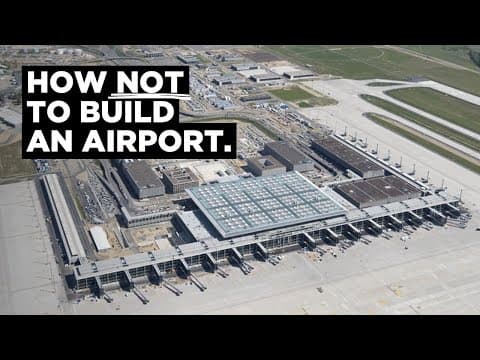
Berlin Brandenburg Airport, initially a symbol of hope and unity, faced decades of delays and mismanagement before finally opening in 2020. Despite its troubled past, it has emerged as a modern airport, winning awards for innovation and efficiency.
Berlin Brandenburg Airport, a project that began in the early 1990s, has had a tumultuous history marked by delays, mismanagement, and a staggering budget increase. Initially envisioned as a symbol of a unified Berlin after the fall of the Berlin Wall, it became a cautionary tale of bureaucratic inefficiency and construction chaos. This blog post explores the airport's journey from its controversial beginnings to its eventual opening and current status as a modern aviation hub.
The conception of Brandenburg Airport was rooted in the desire to create a modern international gateway for a newly unified Berlin. Following the fall of the Berlin Wall in 1989, the city’s population doubled, necessitating a significant upgrade to its aviation infrastructure. The existing airports—Tegel, Tempelhof, and Schönefeld—were outdated and unable to accommodate the demands of a growing capital. The plan was to consolidate these airports into a single, world-class facility that would symbolize Germany's reunification and its aspirations as a European power.
The journey to build Brandenburg Airport was fraught with challenges. After six years of deliberation, the site was chosen next to Schönefeld Airport, and construction finally began in 2006. However, the project was soon hampered by the global financial crisis of 2007-2008, which complicated funding and contractor availability. In an attempt to cut costs, the project was divided into numerous smaller contracts, leading to a convoluted management structure that proved difficult to oversee.
Meinhard von Gerkan, the chief architect, faced immediate conflicts with city politicians over the airport's design. His vision of a minimalist airport with few shops clashed with the expectation that retail would generate significant revenue. Additionally, the airport was required to accommodate the Airbus A380, which was no longer in production by the time the airport opened. These design changes and unrealistic deadlines led to a series of missed target dates, culminating in a disastrous inspection just weeks before the planned opening in 2012, which revealed critical faults in the fire safety system.
As investigations into the construction revealed over 550,000 faults, the budget ballooned from an initial estimate of €2 billion to over €7 billion. The project faced calls for cancellation, but with so much already invested, it was deemed too late to abandon it. The years dragged on, with the airport missing multiple opening dates until it finally opened on October 31, 2020.
The timing of the airport's opening could not have been worse, coinciding with the onset of the COVID-19 pandemic, which drastically reduced international travel. However, this unexpected turn of events allowed the airport to address operational issues without the intense public scrutiny that would have accompanied a normal opening. By the time travel rebounded in 2022 and 2023, Brandenburg Airport had resolved many of its initial problems.
Today, Brandenburg Airport stands as a testament to resilience and innovation. It has won the Airport Innovation Award in 2023, surpassing established competitors like Vienna and Frankfurt. An audit by Skytrax awarded it four stars for efficiency and service quality, and it has become one of the first airports globally to implement AI in its operations for real-time aircraft handling analysis.
The story of Berlin Brandenburg Airport serves as a reminder of the complexities involved in large infrastructure projects. While its journey was marred by delays and mismanagement, the airport has finally fulfilled its promise of serving a unified Berlin. It now stands ready to welcome generations who will experience the city as their parents envisioned—a fully integrated capital, thriving on the cutting edge of modern aviation. The airport may have taken longer to realize than anticipated, but it has officially taken flight, marking a new chapter in Berlin's history.