
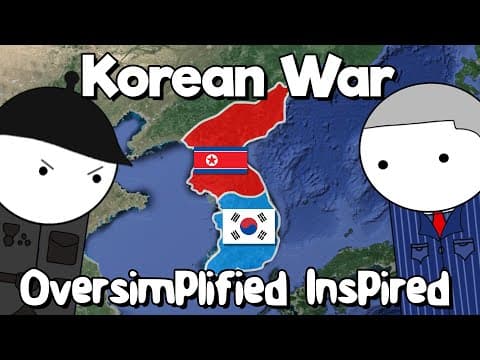
The Korean War (1950-1953) was a significant conflict shaped by post-WWII geopolitical tensions and ideological struggles between communism and capitalism. It began with North Korea's invasion of South Korea, leading to a multinational response led by the US. The war featured intense battles, trench warfare, and ended with an armistice, leaving the Korean Peninsula divided and in a state of ongoing tension. Its legacy continues to influence global politics and the region today.
The Korean War was a pivotal conflict that unfolded against the backdrop of post-World War II geopolitical rearrangements and the intensifying ideological struggle between communism and capitalism. Spanning from 1950 to 1953, the war left an undeniable mark on the Korean Peninsula and echoed across the global stage, shaping alliances, defining military strategies, and influencing diplomatic relations.
The origins of the Korean War can be traced to the division of the Korean Peninsula along the 38th parallel, a consequence of the post-war agreement between the Soviet Union and the United States. This division led to the establishment of two separate entities:
This mix of ideological differences and the strategic interests of major powers set the stage for a proxy war in the early years of the Cold War.
The tension erupted into open hostilities on June 25, 1950, when North Korean forces, led by Kim Il-sung, launched a surprise invasion of South Korea. The international community viewed this as a threat to global peace and swiftly responded through the United Nations, authorizing a multinational force to repel the aggression. The United States played a central role in the conflict, committing a substantial military presence under the command of General Douglas MacArthur.
One of the most pivotal moments occurred in September 1950 with the audacious Inchon Landing, a successful amphibious operation that led to the recapture of Seoul and a rapid reversal of North Korean advances. However, the conflict took an unexpected turn when China intervened, fearing an encroachment on its border. This massive intervention dramatically altered the trajectory of the war.
The subsequent years witnessed a grueling and often overlooked phase of trench warfare reminiscent of the brutality seen in World War I. The battle lines shifted back and forth as both sides engaged in intense struggles for territorial dominance. Severe winters compounded the challenges faced by soldiers on both fronts, with notable engagements such as the Battle of Pork Chop Hill adding to the war's toll.
The protracted nature of the conflict prompted armistice negotiations, which commenced in 1951 but dragged on for two years before an agreement was finally reached on July 27, 1953. The armistice established the Demilitarized Zone (DMZ) along the 38th parallel, creating a tense and heavily fortified buffer between North and South Korea. Critically, the war concluded with an armistice rather than a peace treaty, leaving the Korean Peninsula technically still in a state of war.
Beyond the military and geopolitical aspects, the Korean War had far-reaching consequences for global politics. It solidified the division of the Korean Peninsula, shaping the Cold War dynamics in Asia and reinforcing the U.S. policy of containment against the spread of communism. This theme would become a recurring motif throughout the Cold War.
The conflict exacted a heavy human toll, with millions losing their lives and families being separated. This contributed significantly to the enduring tensions and unresolved issues on the Korean Peninsula that persist to this day.
In the broader historical context, the Korean War stands as a pivotal chapter, with its complexities and repercussions influencing subsequent decades of international relations. Its legacy remains embedded in the political and social fabric of the region, underscoring the enduring impact of a conflict that, despite its significance, often resides in the shadow of other major historical events.
The Korean War, with its intricate web of geopolitical intricacies and human experiences, serves as a testament to the complexities of modern warfare and the lasting consequences of decisions made in the crucible of global conflict.



















