
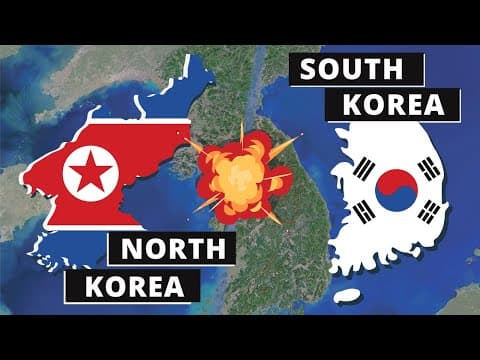
The Korean War, a significant conflict during the Cold War, resulted in the division of Korea into North and South, with lasting global implications. This blog post explores the war's origins, key events, and its enduring impact on international relations and military strategies.
The Korean War, which erupted in 1950, marked a pivotal moment in the Cold War, escalating tensions between Western nations and the Soviet Union. This brutal conflict resulted in millions of deaths, including a significant number of casualties among United Nations forces. Despite being largely forgotten today, the war's legacy continues to influence global politics and military strategies.
In 1910, Korea was annexed by Japan, which controlled the peninsula for 35 years until the end of World War II in 1945. Following Japan's defeat, Korea was liberated but subsequently divided into two occupation zones along the 38th parallel. The northern zone was administered by the Soviet Union, while the southern zone fell under the control of the United States.
By 1948, the occupation zones had evolved into two independent states: the Communist Democratic People's Republic of Korea (North Korea), led by Kim Il-sung, and the capitalist Republic of Korea (South Korea), led by Syngman Rhee. Both governments claimed to be the legitimate rulers of all of Korea, rejecting the division and setting the stage for conflict.
In 1949, the Communist Party of China, led by Mao Zedong, emerged victorious in the Chinese Civil War. This victory prompted the Chinese government to support North Korea militarily, providing training and resources to strengthen its army. Meanwhile, the United States withdrew its forces from South Korea, leaving the South Korean military vulnerable.
Believing that he could easily conquer South Korea, Kim Il-sung launched an invasion on June 25, 1950. The North Korean People's Army swiftly advanced, capturing Seoul by June 28. However, the South Korean forces managed to establish a defensive line south of the Han River, avoiding immediate defeat.
As the situation escalated, the United States sought assistance from the United Nations (UN). The UN passed resolutions condemning the invasion and calling for military support for South Korea. The Soviet Union, boycotting the UN Security Council at the time, did not veto the resolutions, allowing a multinational UN force to be deployed.
In July 1950, UN troops, including forces from the United States, United Kingdom, Canada, and others, arrived in South Korea. Initially, they were pushed back to a small area around the port of Pusan. However, by August, the UN forces began to stabilize the front lines with effective military strategies, including the use of tanks and air support.
A significant turning point occurred in September 1950 when General Douglas MacArthur orchestrated a surprise amphibious landing at Incheon. This maneuver forced North Korean troops to retreat and allowed UN forces to recapture Seoul by September 28.
Following the recapture of South Korea, President Truman authorized an invasion of North Korea, aiming to unify the peninsula under a non-communist government. UN forces captured Pyongyang on October 12 and advanced towards the Yalu River, bordering China.
In response to the UN's advances, China deployed 250,000 troops to support North Korea. This intervention led to heavy losses for UN forces, and by January 1951, Seoul was once again under North Korean control.
As the war dragged on, the Truman Administration shifted its focus from unification to containment, aiming to avoid a broader conflict with China and the Soviet Union. General MacArthur's public disagreements with the administration led to his dismissal in April 1951, with General Matthew Ridgway taking command.
After years of stalemate, President Dwight D. Eisenhower sought to end hostilities through a combination of diplomacy and military pressure. On July 27, 1953, an armistice was signed, effectively ending organized combat operations but leaving the Korean Peninsula divided along the 38th parallel.
The armistice did not result in a peace treaty, and technically, the Korean War remains unresolved. The two Koreas have since existed in a state of ceasefire, with a demilitarized zone (DMZ) established to separate them.
The Korean War demonstrated the willingness of Western allies to combat aggression, reinforcing military alliances such as NATO. It also prompted the United States to continue investing in its military capabilities, shaping international relations for decades to come.
As we reflect on the Korean War, it is crucial to recognize its enduring legacy. Nearly 70 years after the armistice, the Korean Peninsula remains divided, raising questions about the future of reunification. The war's impact on global politics and military strategies continues to resonate, reminding us of the complex interplay between ideology, power, and conflict in shaping our world.



















