
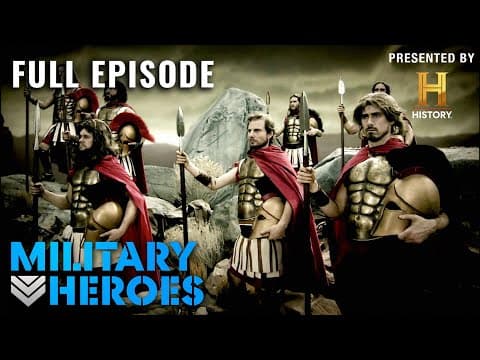
The Battle of Thermopylae in 480 BC saw King Leonidas and 300 Spartans make a legendary last stand against the massive Persian army, ultimately shaping the course of Western civilization and democracy.
In the narrow Thermopylae Pass in northern Greece, 7,000 ancient Greek soldiers awaited an onslaught of epic proportions. They were about to face the largest fighting force ever assembled at the time—nearly 300,000 soldiers of the mighty Persian Empire. Leading the Greeks were 300 of the most ferocious warriors of the ancient world: the Spartans.
In 480 BC, King Xerxes, ruler of the Persian Empire, arrived in Northeastern Greece with the intention of conquering Athens. The Persian army was the largest and most sophisticated military force of its day, capable of fielding 100,000 men in battle. For this invasion, modern estimates suggest Xerxes mustered an army of about 300,000, with some historians believing the number could have been as high as two million.
The Persian Empire stretched from the Indus River in India to the Nile River in Egypt, making it the largest empire of the ancient world. Xerxes had spent five years assembling soldiers, building ships, and gathering supplies for his invasion, aiming to punish Athens for its support of a rebellion against Persia 25 years earlier. This invasion threatened to extinguish the nascent democracy of Athens, which was still in its infancy.
Xerxes marched 850 miles around the Aegean Sea to reach Thermopylae, a narrow pass where the Greeks had staged their defense. The pass was only about 200 yards wide at its widest point, flanked by steep cliffs on either side. This geographical feature provided a strategic advantage to the Greeks, allowing them to hold off a much larger force by funneling the Persians into a confined space.
The Greek coalition army, led by King Leonidas of Sparta, included soldiers from various city-states, marking a rare moment of unity among the often-warring Greek factions. Leonidas was chosen to lead this coalition, and he selected his finest warriors, ensuring that only those who had fathered sons would fight, preserving their bloodline.
As the battle commenced, Xerxes attempted to intimidate the Greeks by sending a messenger to demand their surrender. Leonidas famously replied, "Then we shall have our battle in the shade," showcasing the Spartans' resolve. The Greeks formed a phalanx, a tight formation that maximized their defensive capabilities against the Persian onslaught.
The first day of battle saw the Persian archers unleash a barrage of arrows, but the Greek armor proved effective against the assault. The Spartans, trained from a young age in the art of war, held their ground, and the Persian forces, unaccustomed to fighting in such conditions, suffered heavy casualties.
Despite their initial success, the Greeks faced a dire situation when a Greek traitor revealed a hidden path to Xerxes, allowing him to outflank the Greek position. As the Persian forces began to surround them, Leonidas ordered a tactical retreat for most of the Greek troops, but he and his 300 Spartans, along with about 1,000 Thespians, chose to stay and fight to the death.
This decision was steeped in Spartan culture, where honor and sacrifice for the state were paramount. Leonidas believed that his death could serve a greater purpose, buying time for the rest of Greece to prepare for the inevitable Persian advance.
On the third day of battle, the remaining Greek forces prepared for their last stand. The Spartans fought valiantly, displaying extraordinary bravery and skill. However, they were ultimately overwhelmed by the sheer numbers of the Persian army. Leonidas fell in battle, and his body was fiercely contested by the Persians, who sought to demoralize the Greeks.
Despite their defeat, the sacrifice of Leonidas and his men became a symbol of courage and resistance against tyranny. Their stand at Thermopylae delayed the Persian advance and allowed other Greek city-states to unite against the common enemy.
Xerxes eventually marched into Athens, burning the city to the ground, but the spirit of resistance ignited by the Spartans at Thermopylae lived on. Themistocles, the Athenian commander, regrouped the Greek navy and achieved a decisive victory at the Battle of Salamis, which marked a turning point in the war against Persia.
The legacy of Thermopylae transcends the battlefield. It symbolizes the struggle for freedom and democracy against overwhelming odds. The courage displayed by Leonidas and his 300 Spartans inspired future generations and became a foundational story in the narrative of Western civilization.
The Battle of Thermopylae was not just a military engagement; it was a pivotal moment in history that shaped the future of Greece and the concept of democracy. The sacrifice of the Spartans ensured that the ideals of freedom and self-governance would endure, ultimately influencing the course of Western civilization for centuries to come. The memory of their bravery continues to resonate, reminding us of the power of unity and the enduring human spirit in the face of adversity.



















